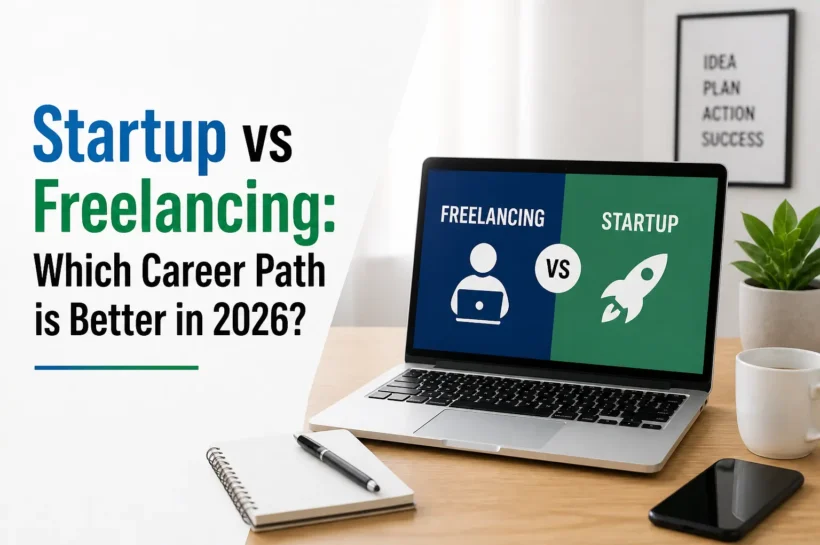

Startup vs Freelancing: Which Career Path is Better in 2026?
In today’s digital economy, choosing between freelancing and launching a startup has become one of the most important career decisions. With remote work expanding rapidly and global platforms opening new income streams, individuals now have more control over how they earn and grow. According to reports from platforms like Upwork, freelance work contributes over $1 trillion annually to the global economy, while startups continue to drive innovation and wealth creation. This article breaks down both paths in depth, helping you understand which option aligns better with your financial goals, risk tolerance, and long-term vision in 2026.
Freelancing Overview
Freelancing is a flexible, skill-based career model where individuals offer services to clients without long-term employment commitments. It has grown significantly due to digital platforms, allowing professionals to work with clients worldwide. Freelancers typically operate in fields like writing, design, programming, and marketing. The biggest advantage is low entry barriers, often requiring just a laptop and a marketable skill. However, success depends heavily on consistency, client acquisition, and personal branding. Freelancing is especially appealing for beginners who want quick income without large investments or business complexities.
Income Model and Work Structure
Freelancers usually earn through hourly rates, fixed-price projects, or retainers. This means income is directly tied to the amount of work completed, often referred to as active income. While this allows quick cash flow, it also limits scalability. According to a Payoneer report, top freelancers can earn significantly more than traditional employees, but income can fluctuate due to inconsistent client demand and market competition.
Startup Overview
A startup is a business designed to scale rapidly by offering innovative products or services. Unlike freelancing, startups focus on building systems, teams, and assets that generate revenue beyond individual effort. Startups can operate in industries like technology, e-commerce, SaaS, or services. While they offer high earning potential, they also require time, capital, and strategic planning. Data from CB Insights shows that nearly 90% of startups fail, often due to poor market fit or financial mismanagement, making this path riskier but potentially more rewarding.
Business Model and Growth Strategy
Startups generate income through scalable models such as product sales, subscriptions, or platform-based services. Unlike freelancing, the goal is to build a system that works independently of the founder’s time. This allows for exponential growth. However, achieving this requires strong leadership, market research, and the ability to adapt quickly in competitive environments.
Startup vs Freelancing: Key Differences
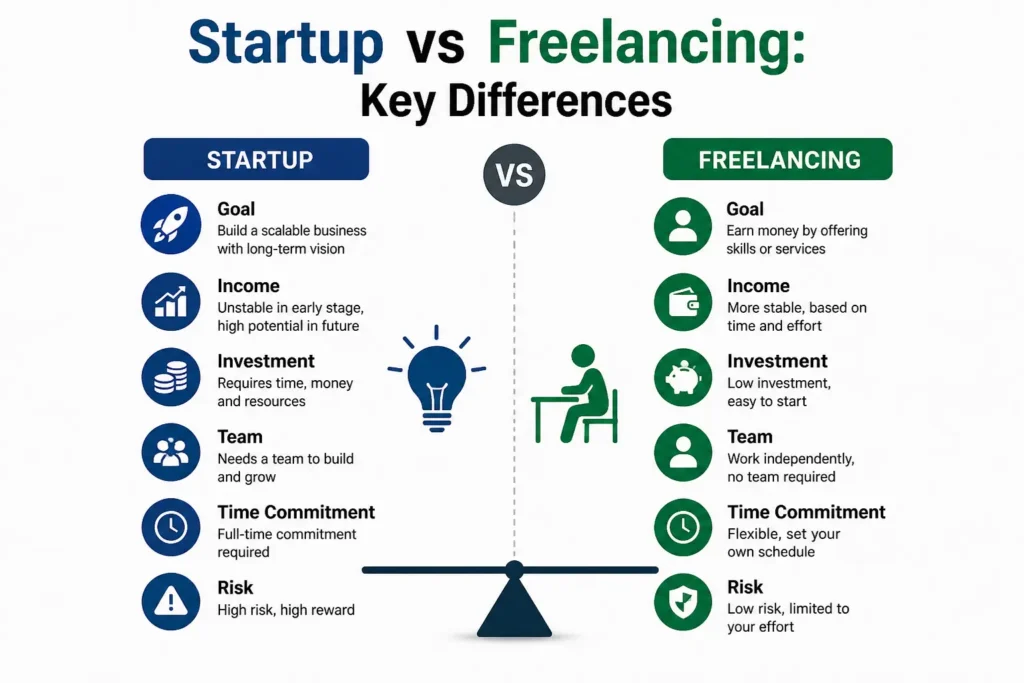
The core difference between freelancing and startups lies in how income is generated and scaled. Freelancing offers immediate earning opportunities with minimal investment, while startups require upfront effort and resources but offer long-term growth potential. Freelancers work independently, focusing on delivering services, whereas startup founders build teams and systems. Risk levels also vary significantly. Freelancing is relatively low-risk, while startups involve uncertainty and financial exposure. Understanding these differences is crucial because your choice should depend on your current situation, financial stability, and long-term career ambitions rather than short-term trends.
💚 You might also like: ChatGPT vs Gemini vs Claude 2026 – Which AI Is Best?
Earning Potential Comparison
When comparing earning potential, freelancing and startups follow completely different trajectories. Freelancing provides faster short-term income, making it ideal for those who need immediate cash flow. On the other hand, startups may take months or even years to become profitable, but can generate significantly higher returns over time. Research shows that successful startup founders can build multi-million-dollar businesses, while freelancers often face income ceilings unless they expand into agencies. Ultimately, freelancing offers stability in the short run, whereas startups provide opportunities for long-term wealth creation and financial independence.
Risk and Investment Analysis
Risk and investment are critical factors when choosing between freelancing and a startup. Freelancing typically requires minimal upfront investment, often just essential tools, software, and internet access. This makes it a low-risk entry point for most individuals. In contrast, startups usually demand higher capital, whether for product development, marketing, or hiring a team. According to CB Insights, one of the top reasons startups fail is running out of cash. This highlights the financial uncertainty involved. While freelancing offers stability and lower financial exposure, startups involve calculated risks that can either lead to significant rewards or substantial losses.
Flexibility and Lifestyle Impact
One of the biggest advantages of freelancing is the level of flexibility it provides. Freelancers can choose their working hours, clients, and even the type of projects they want to handle. This autonomy allows for better work-life balance, especially for individuals seeking location independence. Startups, however, often demand long hours, especially in the early stages. Founders frequently work under pressure to meet deadlines, secure funding, and grow their business. While startups may eventually offer freedom, the initial phase can be highly demanding, making freelancing a more lifestyle-friendly option in the short term.
Scalability and Growth Potential
Scalability is where startups clearly outperform freelancing. Freelancers are limited by time since income depends on personal effort. Even if rates increase, there is a natural cap on how much one can earn individually. Startups, on the other hand, are designed to grow beyond the founder’s direct involvement. By building systems, hiring teams, and leveraging technology, startups can scale rapidly. According to a report by Statista, scalable businesses, especially in tech sectors, have the highest potential for exponential growth. This makes startups ideal for those aiming to build long-term assets rather than short-term income streams.
Active vs Passive Income
Freelancing primarily generates active income, where earnings are directly linked to the work performed. This means no work often results in no income. Startups, however, can create passive or semi-passive income streams through automated systems, subscriptions, or digital products. While building passive income takes time, it allows entrepreneurs to earn without constant involvement, offering greater financial freedom in the long run.
Pros and Cons Comparison
Both freelancing and startups come with their own advantages and limitations. Freelancing offers quick entry, flexible schedules, and immediate income, making it ideal for beginners. However, it lacks scalability and often leads to income instability over time. Startups, on the other hand, provide opportunities for massive growth, brand building, and long-term wealth creation. The downside is the high risk, financial pressure, and delayed returns. According to multiple industry reports, most individuals start with freelancing and eventually transition into startups once they gain experience, capital, and confidence.
How to Choose the Right Path
Choosing between freelancing and a startup depends on your personal goals, financial situation, and risk tolerance. If you need immediate income with low risk, freelancing is a better option. However, if you are willing to take risks for higher long-term rewards, a startup may be the right path. It’s important to evaluate your skills, available resources, and long-term vision before making a decision. Many successful entrepreneurs recommend starting with freelancing to build financial stability and then transitioning into a startup once you have enough experience and capital.
Expert Tips to Succeed in Freelancing or Startups
Success in either path requires more than just skills it demands strategy, consistency, and adaptability. For freelancers, building a strong personal brand and maintaining long-term client relationships is key. For startup founders, validating ideas and managing finances effectively are critical factors. Research from Harvard Business Review highlights that adaptability and continuous learning are among the top traits of successful entrepreneurs. Regardless of the path you choose, focusing on problem-solving and delivering real value will significantly increase your chances of long-term success in an increasingly competitive digital landscape.
Common Mistakes to Avoid
Many beginners make the mistake of choosing a path based on trends rather than personal suitability. In freelancing, relying on a single client or underpricing services can limit growth and stability. In startups, skipping market research or scaling too quickly often leads to failure. According to CB Insights, lack of product-market fit is one of the biggest reasons startups fail. Avoiding these common pitfalls requires careful planning, realistic expectations, and a willingness to learn from mistakes while continuously improving your approach.
Future Trends – Freelancing and Startups in 2026
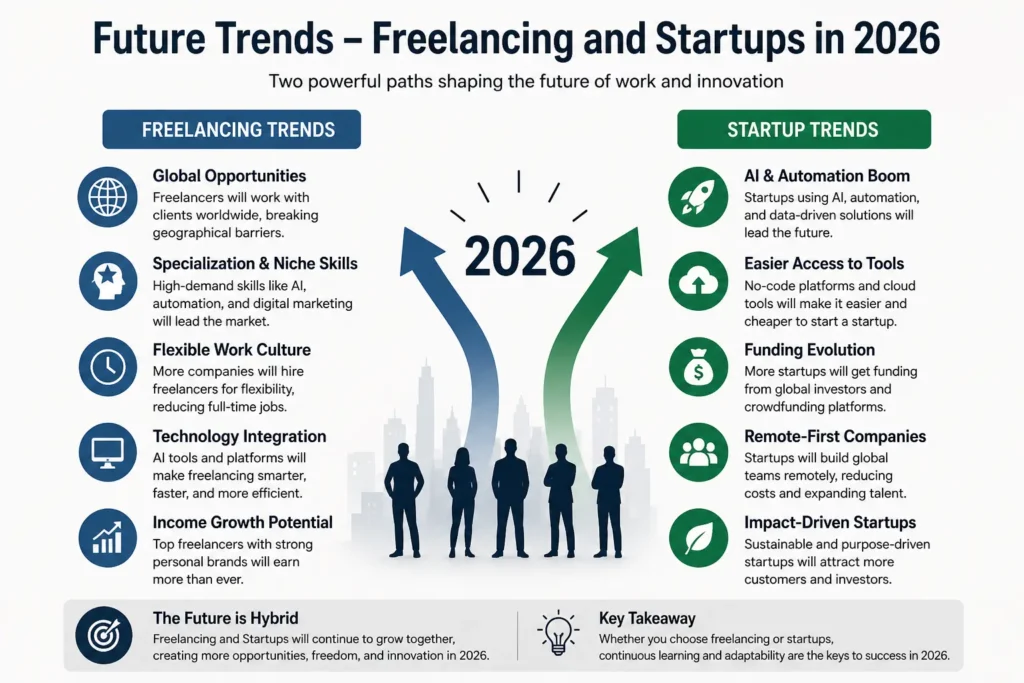
The future of work is rapidly evolving, and both freelancing and startups are expected to grow significantly. Reports suggest that remote work and the gig economy will continue expanding, making freelancing more accessible globally. At the same time, advancements in technology such as AI and automation are enabling startups to scale faster than ever before. Platforms, tools, and digital ecosystems are reducing entry barriers, allowing individuals to experiment with both paths. This shift indicates that the line between freelancing and startups will become increasingly blurred in the coming years.
💚 You might also like: Android vs iPhone 2026 – Which Smartphone Is Better?
Conclusion
Choosing between freelancing and a startup depends on your goals, resources, and risk tolerance. Freelancing is best for those who want quick income, flexibility, and low entry barriers, while startups are ideal for individuals aiming to build scalable businesses and long-term wealth. In today’s digital economy, both paths offer strong opportunities, but they serve different purposes. The smartest approach is to start where you are comfortable, build skills and stability, and then gradually move toward larger goals as your experience and confidence grow over time.
FAQs – Startup vs Freelancing
Is freelancing better than a startup for beginners?
Freelancing is generally better for beginners because it requires minimal investment and provides immediate earning opportunities. It allows individuals to build skills, gain experience, and understand market demand without taking significant financial risks, making it an ideal starting point for most people entering the digital economy.
Can freelancing make you wealthy?
Freelancing can generate a high income, especially for skilled professionals, but it often has scalability limits. To build long-term wealth, many freelancers expand into agencies, digital products, or startups, which provide additional income streams beyond direct client work.
Why do most startups fail?
Most startups fail due to factors like poor market demand, lack of funding, and ineffective business strategies. Research by CB Insights shows that failure often results from not solving a real problem or running out of financial resources before achieving profitability.
Which option is better for passive income?
Startups are better suited for building passive or semi-passive income streams through scalable systems, automation, or digital products. Freelancing typically relies on active income, where earnings depend directly on ongoing work.
Can freelancers transition into startups successfully?
Yes, many successful entrepreneurs begin as freelancers. This path allows them to gain practical experience, build capital, and understand customer needs, making the transition into a startup more strategic and less risky.
Tech made simple, follow Tech Baaz for more.