
Introduction
Over the past few years, AI coding tools have moved from experimental projects to everyday developer companions, helping teams ship code faster than ever before. This rapid evolution has sparked a big question across the industry: Will these tools eventually replace human developers? While the fear sounds reasonable, the reality is more nuanced. AI is not eliminating developers; it’s transforming their role, changing how they work, and redefining what it means to be a software engineer today.
What Are AI Coding Tools?
AI coding tools are software powered by machine learning models, especially large language models, that assist developers in writing, analyzing, and optimizing code. Tools like GitHub Copilot and ChatGPT can generate entire code snippets, suggest improvements, and even explain complex logic in seconds. They work by training on massive datasets of publicly available code and patterns. These tools are designed to augment human capabilities, not replace them, by handling repetitive tasks and boosting overall productivity in modern development workflows.
Current Capabilities & Limitations of AI in Software Development
Today’s AI coding tools are surprisingly capable, handling a wide range of development tasks with impressive accuracy. They can generate boilerplate code, suggest real-time completions, and even detect bugs before execution. Developers also rely on AI for writing documentation and generating test cases, saving hours of manual effort.
According to a Stack Overflow developer survey, over 70% of developers are already using or planning to use AI tools. However, while these tools excel at assisting with well-defined tasks, they still depend heavily on human guidance for context, validation, and complex decision-making.
Despite their impressive capabilities, AI coding tools are far from perfect and come with several important limitations. They often lack a deep understanding of context, which can lead to incorrect or inefficient code suggestions. Security is another concern, as AI-generated code may introduce vulnerabilities if not carefully reviewed.
Additionally, these tools struggle with complex system design and long-term architectural decisions. There are also ethical and legal questions around code ownership and data usage. Ultimately, AI tools require human oversight, making developers essential for ensuring quality, accuracy, and reliability in software projects.
Can AI Replace Software Developers in 2026?
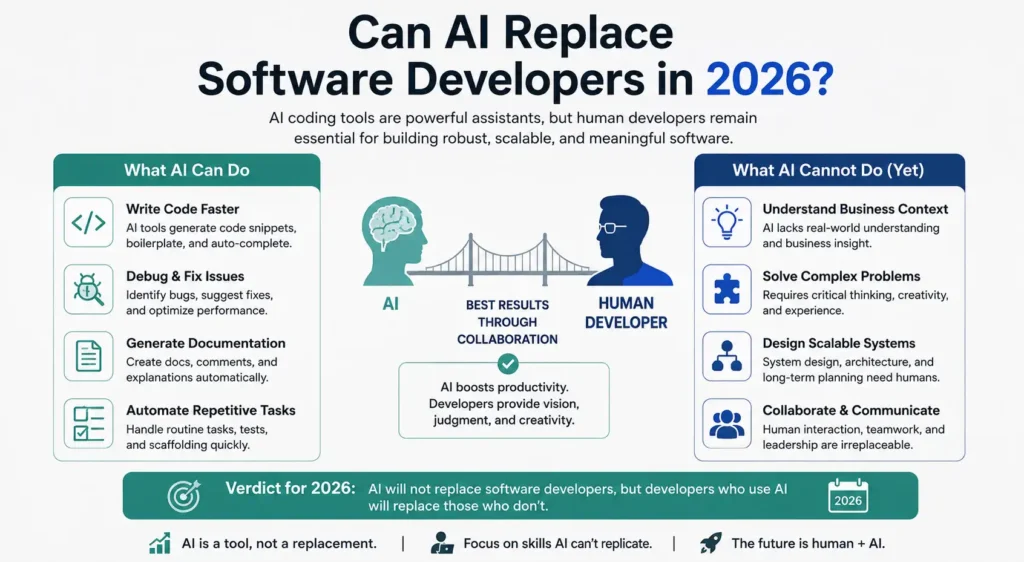
The question of whether AI can replace software developers is at the center of an ongoing debate in the tech industry. While AI tools are becoming increasingly powerful, they are still fundamentally limited in their ability to think, reason, and understand real-world problems. Software development is not just about writing code it involves designing systems, solving complex problems, and collaborating with teams. AI can assist with certain aspects of development, but it cannot fully replicate human creativity and judgment. Instead of replacing developers, AI is more likely to act as a powerful assistant that enhances their productivity and efficiency.
Tasks AI Can Replace
AI coding tools are particularly effective at handling repetitive and well-structured tasks that follow predictable patterns. This includes generating boilerplate code, creating simple scripts, and building basic front-end or back-end components. These tasks don’t require deep reasoning, making them ideal for automation. By taking over such work, AI allows developers to focus on higher-value activities that require critical thinking and innovation.
Tasks AI Cannot Replace (Yet)
There are several areas where AI still falls short, especially when it comes to complex problem-solving and decision-making. Designing scalable system architectures, understanding business requirements, and collaborating with stakeholders require human insight. Creativity, innovation, and critical thinking remain uniquely human strengths. AI lacks true understanding and cannot independently make strategic decisions, which keeps developers at the center of the software development process.
💚 You might also like: Frontend vs Backend Development: Career Guide(2026)
How AI Is Changing the Role of Developers & Its Impact on Jobs
AI is not replacing developers, it’s reshaping their responsibilities in meaningful ways. Instead of spending most of their time writing repetitive code, developers are now focusing more on problem-solving, system design, and strategic decision-making. They are becoming supervisors of AI-generated output, reviewing and refining code to ensure quality.
This shift is giving rise to a new development approach known as AI-assisted programming. As a result, developers need to adapt by learning how to effectively use AI tools, making them more productive and valuable in modern software development environments.
The rise of AI coding tools has sparked widespread concern about job security in the software industry, but the reality is more about transformation than elimination. According to the World Economic Forum, AI is expected to create 97 million new jobs globally by 2025, even as it automates others.
In software development, routine tasks are being automated, but the demand for skilled developers remains strong. Companies are shifting hiring strategies, prioritizing problem-solving and system design skills. Instead of replacing jobs entirely, AI is reshaping roles, pushing developers to adapt and evolve alongside rapidly advancing technologies.
Upcoming Advancements of AI in Programming
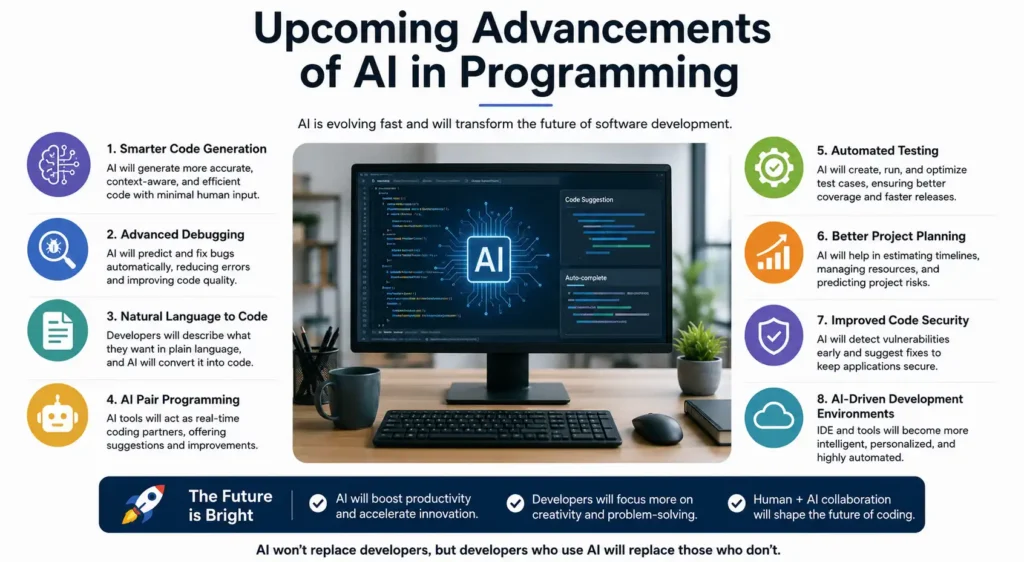
The future of AI in programming is centered on collaboration rather than replacement. Over the next 5 to 10 years, AI tools are expected to become even more advanced, capable of handling larger portions of the development lifecycle. However, human developers will remain essential for guiding these systems and making critical decisions. Research from Gartner suggests that by 2030, most software development tasks will involve AI assistance. This shift will lead to faster development cycles, improved efficiency, and new opportunities, but it will also require developers to adapt to an increasingly AI-driven workflow.
Predictions for Next 5–10 Years
In the coming decade, AI coding tools will likely become more accurate, context-aware, and integrated into development environments. They may handle complex debugging and optimization tasks, but complete autonomy remains unlikely. Human oversight will continue to play a crucial role in ensuring quality, security, and innovation in software development.
AI-Human Collaboration Model
The most realistic future is one where AI and developers work together as a team. AI handles repetitive and time-consuming tasks, while developers focus on strategy, design, and problem-solving. This collaboration increases productivity and allows teams to deliver high-quality software faster without sacrificing creativity or innovation.
Evolution of Development Workflows
Development workflows are already evolving with the integration of AI tools. Tasks like testing, documentation, and code reviews are becoming more automated. This allows developers to focus on higher-level responsibilities. As AI continues to improve, workflows will become more streamlined, efficient, and less dependent on manual processes.
Potential Risks and Opportunities
While AI presents significant opportunities, it also introduces risks. Over-reliance on AI could reduce critical thinking skills, and poorly generated code may introduce security vulnerabilities. However, for developers who adapt, AI offers a chance to increase productivity, expand skill sets, and stay competitive in a rapidly changing industry.
💚 You might also like: How to Build a Website Step-by-Step (2026 Beginner Guide)
Skills Developers Need to Stay Relevant
As AI continues to reshape software development, developers must adapt by building a diverse and future-proof skill set. Technical knowledge alone is no longer enough developers need to combine strong fundamentals with the ability to work effectively with AI tools. According to industry reports, employers increasingly value problem-solving, system design, and adaptability. Developers who embrace continuous learning and stay updated with emerging technologies will have a clear advantage. By focusing on both technical and soft skills, developers can remain relevant and thrive in an AI-driven development environment.
Strong Fundamentals (Algorithms, Data Structures)
A solid understanding of algorithms and data structures remains essential for developers. These fundamentals enable developers to write efficient and optimized code, something AI tools may not always guarantee. Strong basics also help developers evaluate AI-generated suggestions and make better technical decisions.
System Design and Architecture
System design skills are becoming increasingly important as AI takes over routine coding tasks. Developers must understand how to build scalable, secure, and maintainable systems. This requires a deep understanding of architecture patterns, performance optimization, and real-world problem-solving.
AI Tool Usage and Prompt Engineering
Knowing how to effectively use AI tools is becoming a key skill for modern developers. Prompt engineering, crafting precise instructions for AI systems, can significantly impact the quality of generated code. Developers who master this skill can boost productivity and gain a competitive edge.
Soft Skills (Communication, Critical Thinking)
Soft skills are more important than ever in an AI-driven world. Developers need to communicate ideas clearly, collaborate with teams, and think critically about complex problems. AI cannot replace human judgment, making these skills essential for long-term success.
Continuous Learning Mindset
Technology evolves rapidly, and developers must keep up with constant changes. A continuous learning mindset helps developers stay relevant and adapt to new tools and trends. Those who actively learn and experiment with AI technologies will be better positioned for future opportunities.
Pros and Cons of AI in Software Development
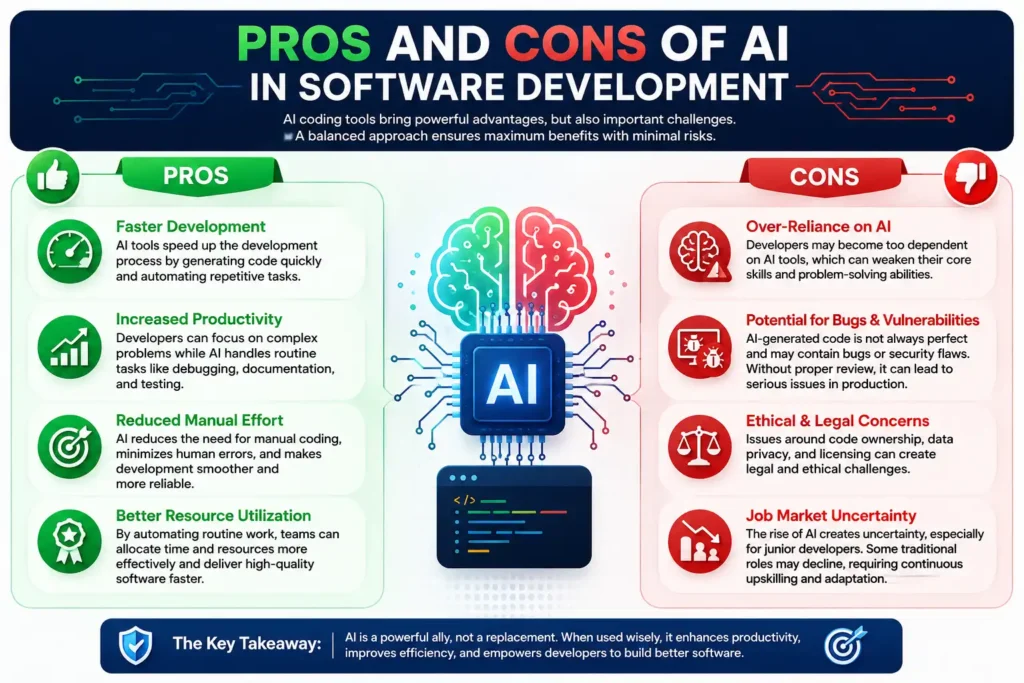
AI coding tools offer significant advantages, but they also come with challenges that developers and organizations must consider. While these tools can dramatically improve efficiency and reduce development time, they are not without risks. Understanding both the benefits and drawbacks is essential for making informed decisions about adopting AI in software development. A balanced approach ensures that teams can maximize productivity while minimizing potential issues related to quality, security, and over-reliance on automation.
Pros
– AI tools can significantly speed up the development process by automating repetitive tasks and generating code quickly. This allows developers to complete projects faster and focus on more complex aspects of development, improving overall productivity and efficiency.
– By handling routine tasks, AI tools enable developers to work more efficiently. They reduce the time spent on debugging, documentation, and testing, allowing teams to allocate resources more effectively and deliver high-quality software within shorter timeframes.
– AI reduces the need for manual coding, especially for repetitive and predictable tasks. This not only saves time but also minimizes human errors, making development processes smoother and more reliable in many cases.
Cons:
– One major concern is that developers may become too dependent on AI tools, potentially weakening their core skills. Over-reliance can lead to reduced problem-solving abilities and a lack of deep understanding of underlying systems.
– AI-generated code is not always perfect and may contain bugs or security vulnerabilities. Without proper review, these issues can lead to serious problems in production environments, making human oversight essential.
– The rise of AI has created uncertainty in the job market, especially for junior developers. While new opportunities are emerging, some traditional roles may decline, requiring developers to adapt and upgrade their skills.
💚 You might also like: How to Use AI for Content Writing (Guide 2026)
Case Studies & Myths
Many companies are already using AI coding tools to improve productivity and streamline development processes. For example, GitHub reports that developers using Copilot can complete tasks significantly faster, leading to measurable efficiency gains. Large tech companies are integrating AI into their workflows to automate testing, code generation, and documentation.
However, developer experiences vary, while some report increased productivity, others highlight challenges related to accuracy and reliability. These real-world examples show that AI is a powerful tool, but its effectiveness depends on how it is used and managed.
There are several misconceptions about AI’s role in software development, often fueled by hype and fear. One common myth is that AI will completely replace developers, which ignores the complexity of real-world programming. Another misconception is that coding skills are no longer necessary, despite the growing demand for skilled developers.
Some also believe that AI is always accurate, when in reality, it can produce incorrect or misleading results. Understanding these myths helps create a more realistic perspective on how AI is actually impacting the industry.
FAQs
Will AI eliminate programming jobs?
AI is unlikely to eliminate programming jobs entirely. Instead, it will automate certain tasks and create new opportunities. Developers who adapt to AI tools and focus on higher-level skills will continue to be in demand.
Is coding still worth learning in 2026?
Yes, coding is still a valuable skill in 2026. While AI tools can assist with coding, understanding programming fundamentals is essential for building, maintaining, and optimizing software systems effectively.
Which developers are most at risk?
Developers who rely solely on repetitive coding tasks without upgrading their skills may face challenges. Those who invest in learning AI tools, system design, and problem-solving will remain competitive.
How can beginners adapt to AI tools?
Beginners can start by learning programming fundamentals and gradually incorporating AI tools into their workflow. Practicing prompt engineering and understanding how AI generates code can help them use these tools more effectively.
Conclusion
AI coding tools are undoubtedly transforming the software development landscape, but they are not replacing developers. Instead, they are acting as powerful assistants that enhance productivity and efficiency. Developers remain essential for problem-solving, system design, and decision-making. The future of software development lies in collaboration between humans and AI, where each complements the other’s strengths. Those who adapt to this change and learn how to leverage AI tools effectively will not only remain relevant but also gain a significant advantage in the evolving tech industry.
✨ Want bite-sized tech wisdom? Follow Tech Baaz.