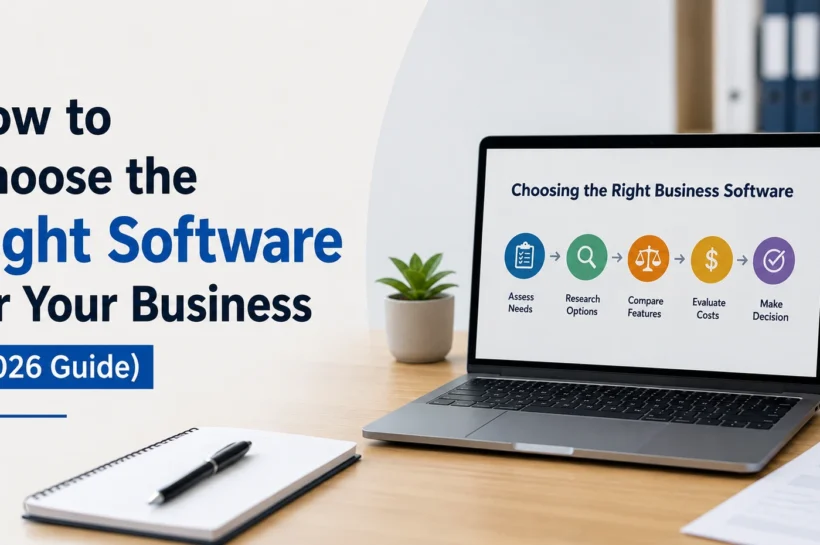

How to Choose the Right Software for Your Business (2026 Guide)
Modern business software refers to digital tools designed to streamline operations, improve collaboration, and enhance decision-making across organizations. In 2026, these solutions are often cloud-based, AI-powered, and integrated across departments such as sales, HR, finance, and operations. According to industry research by Gartner, over 70% of businesses now rely on at least one cloud SaaS platform for core operations. Understanding this landscape helps businesses avoid outdated tools and choose systems that scale with growth, improve productivity, and support data-driven strategies in competitive markets. We must carefully evaluate options before final adoption for long-term success.
Assessing Organizational Requirements
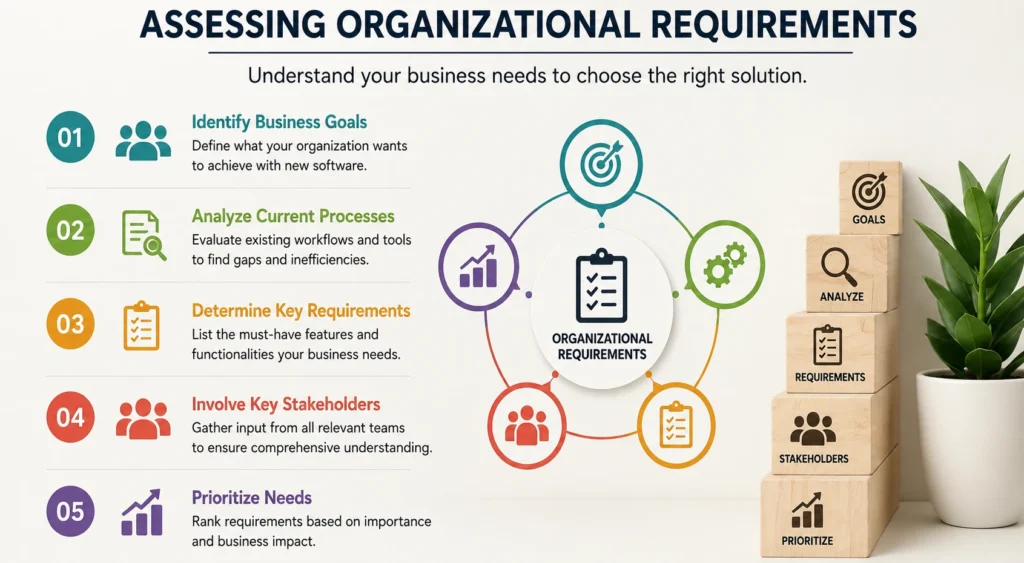
Assessing organizational requirements is the foundation of choosing the right software because every business operates differently. This stage involves understanding internal processes, team structures, communication flows, and operational challenges. Without this clarity, companies often invest in tools that do not align with real needs, leading to wasted budgets and poor adoption rates. Research from McKinsey highlights that digital transformation projects fail 70% of the time due to unclear requirements. A structured assessment ensures better alignment, improved efficiency, and long-term scalability for growing organizations in competitive markets today, which improves overall business performance significantly over time.
💚 You might also like: AxelaNote Review 2026: AI Note-Taking & Productivity Tool
Workflow Analysis and Process Mapping
Workflow analysis and process mapping involve examining how tasks move through different stages within an organization. This helps identify inefficiencies, duplication, and delays in daily operations. By visually mapping workflows, businesses can understand how information flows between teams and systems. This step is essential for selecting software that aligns with real operational needs and improves overall productivity across departments effectively.
Operational Pain Point Identification
Operational pain point identification focuses on discovering the challenges that slow down business performance, such as manual processes, communication gaps, or outdated systems. Identifying these issues allows organizations to prioritize solutions that directly address inefficiencies. This step ensures that software selection is problem-driven rather than feature-driven, leading to better ROI and improved operational effectiveness across the entire organization and overall success.
Defining Strategic Software Objectives
Defining strategic software objectives ensures that technology investments align with long-term business goals rather than short-term fixes. This process helps organizations clarify what they want to achieve, such as improved efficiency, better customer experience, or increased revenue. According to Deloitte, companies with clearly defined digital strategies are 1.8 times more likely to achieve business growth. Setting measurable objectives also helps teams evaluate software performance effectively, ensuring accountability and ROI. This step creates a roadmap for selecting solutions that support sustainable growth and operational excellence in competitive markets across modern global industries today.
Stakeholder Alignment in Software Selection
Stakeholder alignment is a critical step in selecting business software because decisions impact multiple departments. In many organizations, software failure happens not due to poor tools but due to a lack of internal agreement. According to Harvard Business Review, projects with strong stakeholder engagement are 30% more likely to succeed. This stage ensures that leadership, IT teams, and end-users all contribute to the decision-making process. It reduces resistance during implementation and improves adoption rates. When everyone feels involved, the selected software better reflects real operational needs and supports smoother digital transformation across the entire organization effectively and sustainably.
Executive and Leadership Involvement
Executive and leadership involvement ensures that software decisions align with overall business strategy and long-term goals. Leaders focus on ROI, scalability, and competitive advantage, helping guide the direction of selection. Their approval also ensures budget availability and organizational support. Without leadership input, companies often choose tools that lack strategic value or fail to scale. Strong executive participation creates accountability and ensures that the chosen software supports growth, innovation, and overall business performance effectively.
End-User Requirements and Feedback
End-user feedback is essential because employees interact with the software daily. If a system is difficult to use, productivity drops and adoption fails. Gathering input from actual users helps identify usability issues, missing features, and workflow challenges. Studies show that software with a strong user-centered design improves productivity by up to 25%. Including employees in the selection process ensures the final decision is practical, efficient, and aligned with real-world operational needs across teams.
Establishing Functional and Technical Requirements
Establishing functional and technical requirements helps businesses clearly define what the software must do and how it should perform. Functional requirements focus on features like reporting, automation, and task management, while technical requirements cover system performance, scalability, and compatibility. According to IBM research, unclear requirements are one of the top reasons for IT project failure. Defining these details early reduces risks, avoids costly mistakes, and ensures the selected software integrates smoothly into existing systems. This structured approach allows businesses to compare solutions more effectively and choose platforms that meet both operational and technical expectations efficiently.
Selecting the Appropriate Deployment Model
Choosing the right deployment model is important because it affects cost, flexibility, and control. Businesses typically choose between cloud-based, on-premise, or hybrid solutions depending on their needs. Cloud software offers scalability and remote access, while on-premise systems provide greater control and security. Hybrid models combine both advantages for flexibility. According to Flexera’s 2024 report, over 80% of enterprises now use a multi-cloud or hybrid approach. Understanding these options helps organizations select a model that aligns with their infrastructure, budget, and long-term IT strategy while ensuring performance, reliability, and accessibility across all business operations effectively.
Total Cost of Ownership (TCO) Evaluation
Total Cost of Ownership (TCO) evaluation goes beyond the initial purchase price and includes all direct and indirect costs associated with software. This includes licensing fees, implementation costs, training, maintenance, upgrades, and potential downtime. Many businesses underestimate these hidden costs, leading to budget overruns later. According to Forrester Research, maintenance and operational expenses can account for up to 70% of total software costs over time. Evaluating TCO helps businesses make financially responsible decisions and ensures long-term affordability. This approach provides a realistic view of investment value and supports smarter, more sustainable software selection decisions.
Direct, Indirect, and Hidden Costs Assessment
Cost assessment involves analyzing all financial aspects of software ownership. Direct costs refer to expenses like licensing or subscription charges, whereas indirect costs cover areas such as training, onboarding, and system integration efforts. Hidden costs may include system downtime, productivity loss, and future upgrades. Many organizations ignore these hidden expenses, which can significantly impact budgets. A complete cost analysis ensures businesses understand the true financial commitment before investing.
Integration and System Compatibility Analysis
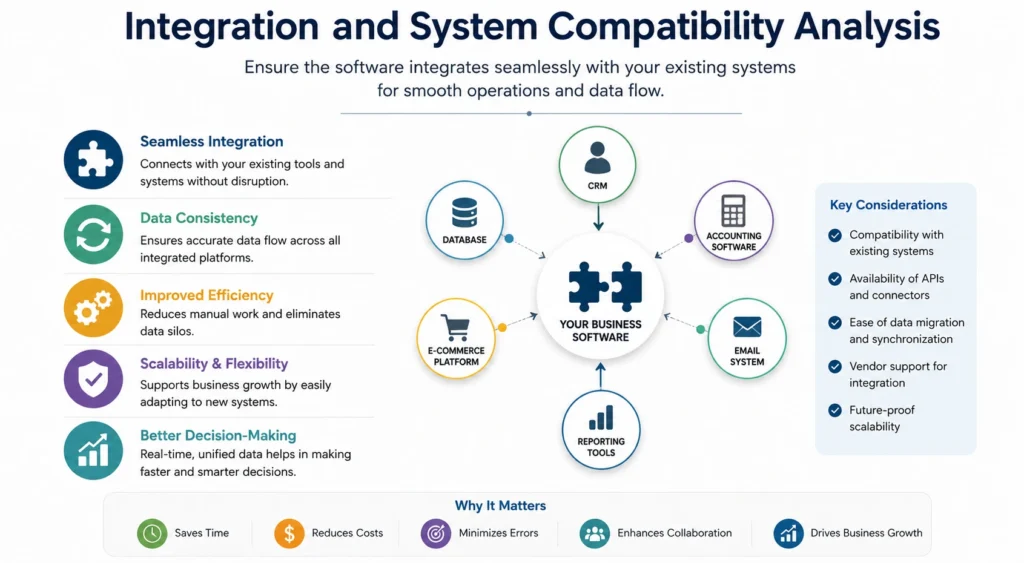
Integration and system compatibility are crucial when selecting business software because modern organizations rely on multiple tools working together. If systems do not integrate properly, it leads to data silos, manual work, and inefficiencies. According to MuleSoft’s Connectivity Benchmark Report, 89% of IT leaders say integration challenges slow down digital transformation. Businesses should evaluate how well new software connects with existing tools like CRM, ERP, accounting, and communication platforms. A well-integrated system improves data flow, reduces duplication, and enhances decision-making speed. This step ensures the software fits seamlessly into the current technology ecosystem without disrupting daily operations.
💚 You might also like: Keyword Research Made Easy – Step-by-Step SEO Tutorial
Security, Governance, and Compliance Considerations
Security, governance, and compliance are non-negotiable factors in software selection, especially as cyber threats continue to rise globally. Businesses must ensure that the software follows industry standards such as GDPR, ISO 27001, or SOC 2, depending on their region and sector. According to IBM’s 2024 Cost of a Data Breach Report, the average breach cost reached $4.45 million, highlighting the importance of strong security measures. Companies should evaluate data encryption, access controls, and audit capabilities before making a decision. Strong governance ensures data integrity, regulatory compliance, and protection against unauthorized access, safeguarding both business operations and customer trust.
Comparative Evaluation and Validation of Solutions
Comparative evaluation and validation help businesses make informed final decisions by testing multiple software options side by side. Instead of relying on marketing claims, organizations should analyze real performance through demos, pilot testing, and user feedback. This stage reduces risk and ensures the selected solution truly meets business needs. Studies by TechRepublic show that companies using structured evaluation frameworks improve software satisfaction rates by over 40%. A clear comparison based on features, usability, scalability, and cost allows decision-makers to confidently choose the best-fit solution. This final validation stage helps secure long-term success while reducing the risk of expensive implementation errors.
Trial Usage and Proof of Concept (POC) Testing
Trial usage and Proof of Concept (POC) testing allow businesses to experience software in real-world scenarios before full adoption. During this phase, teams test core features, performance, and usability under actual workloads. POC helps identify limitations, integration issues, and user challenges early. Many organizations run short pilot programs with selected departments to gather feedback. This practical evaluation ensures that the software delivers expected results and aligns with business requirements. It also increases user confidence and reduces resistance during full deployment, making the final implementation smoother and more successful across the organization.
Integration and System Compatibility Analysis
Integration and system compatibility are crucial when selecting business software because modern organizations rely on multiple tools working together. If systems do not integrate properly, it leads to data silos, manual work, and inefficiencies. According to MuleSoft’s Connectivity Benchmark Report, 89% of IT leaders say integration challenges slow down digital transformation. Businesses should evaluate how well new software connects with existing tools like CRM, ERP, accounting, and communication platforms. A well-integrated system improves data flow, reduces duplication, and enhances decision-making speed. This step ensures the software fits seamlessly into the current technology ecosystem without disrupting daily operations.
Security, Governance, and Compliance Considerations
Security, governance, and compliance are non-negotiable factors in software selection, especially as cyber threats continue to rise globally. Businesses must ensure that the software follows industry standards such as GDPR, ISO 27001, or SOC 2, depending on their region and sector. According to IBM’s 2024 Cost of a Data Breach Report, the average breach cost reached $4.45 million, highlighting the importance of strong security measures. Companies should evaluate data encryption, access controls, and audit capabilities before making a decision. Strong governance ensures data integrity, regulatory compliance, and protection against unauthorized access, safeguarding both business operations and customer trust.
Comparative Evaluation and Validation of Solutions
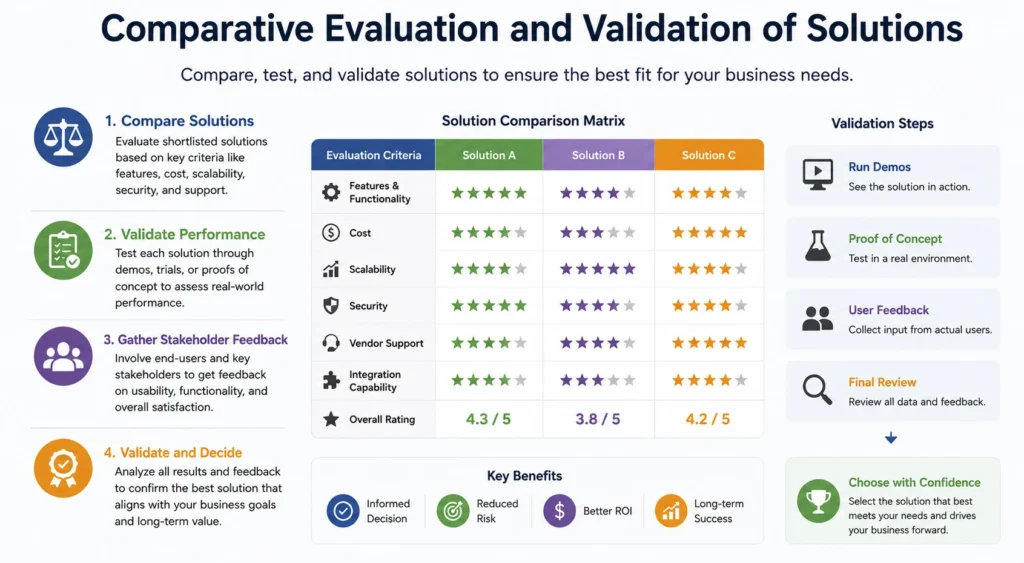
Comparative evaluation and validation help businesses make informed final decisions by testing multiple software options side by side. Instead of relying on marketing claims, organizations should analyze real performance through demos, pilot testing, and user feedback. This stage reduces risk and ensures the selected solution truly meets business needs. Studies by TechRepublic show that companies using structured evaluation frameworks improve software satisfaction rates by over 40%. A clear comparison based on features, usability, scalability, and cost allows decision-makers to confidently choose the best-fit solution. This final validation step supports long-term success and helps avoid costly mistakes during implementation.
Trial Usage and Proof of Concept (POC) Testing
Trial usage and Proof of Concept (POC) testing allow businesses to experience software in real-world scenarios before full adoption. During this phase, teams test core features, performance, and usability under actual workloads. POC helps identify limitations, integration issues, and user challenges early. Many organizations run short pilot programs with selected departments to gather feedback. This practical evaluation ensures that the software delivers expected results and aligns with business requirements. It also increases user confidence and reduces resistance during full deployment, making the final implementation smoother and more successful across the organization.
Conclusion
Choosing the right business software is not just a technical decision; it’s a long-term strategic investment that directly impacts productivity, cost efficiency, and growth. From understanding organizational needs to evaluating integration, security, and total cost, every step plays a critical role in making the right choice. Businesses that follow a structured selection process are more likely to avoid costly mistakes and achieve higher adoption rates. In today’s fast-moving digital environment, the right software can become a competitive advantage, helping companies scale faster, work smarter, and stay aligned with evolving market demands.
FAQs
What is the first step in choosing business software?
Understanding your business needs and workflows is the most important first step.
Why is stakeholder involvement important?
It ensures the software meets real user needs and improves adoption rates.
What is Total Cost of Ownership (TCO)?
TCO includes all direct, indirect, and hidden costs over the software lifecycle.
Why is integration important in software selection?
It allows different systems to work together and improves data flow.
Should businesses test software before buying?
Yes, trials and POCs help verify real-world performance before commitment.
✨ Want bite-sized tech wisdom? Follow Tech Baaz.