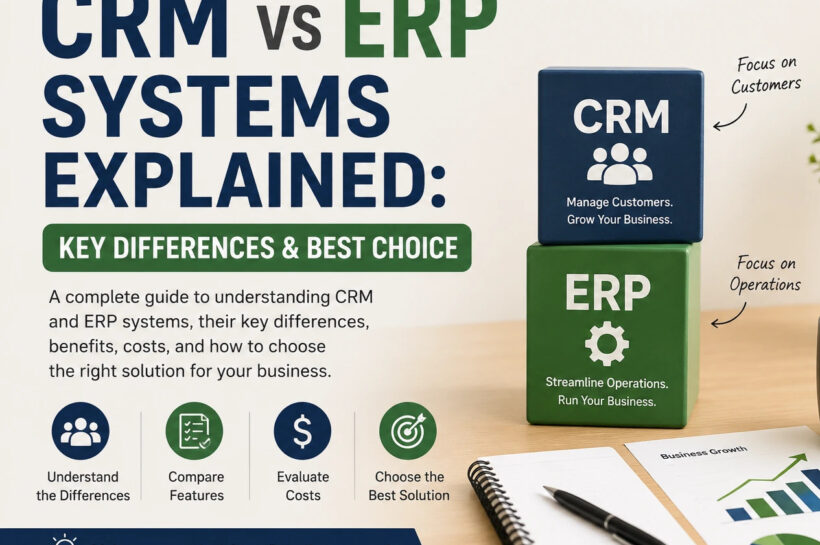

CRM vs ERP Systems Explained: Key Differences & Best Choice
Businesses today rely on software to manage everything from customer relationships to financial operations. Two of the most important business systems are Customer Relationship Management (CRM) and Enterprise Resource Planning (ERP). While these platforms often appear similar because both centralize business data, they serve very different purposes. CRM helps companies attract, engage, and retain customers, while ERP focuses on managing internal operations such as finance, inventory, procurement, and human resources.
Understanding the difference between CRM and ERP is essential for making the right technology investment. Whether you run a small business, a growing startup, or a large enterprise, choosing the right system can improve efficiency, increase revenue, and support long-term growth. This guide explains CRM and ERP systems, their core functions, and how they help organizations achieve different business goals.
Key Features of CRM and ERP
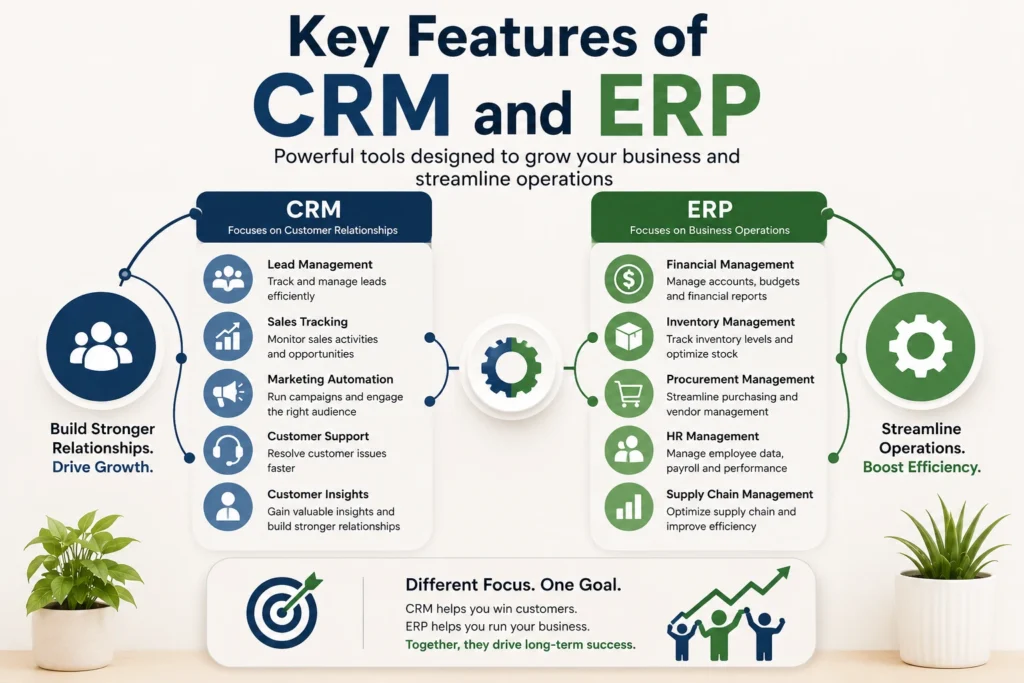
Although CRM and ERP systems serve different purposes, both are designed to improve business efficiency through better data management and automation. CRM platforms focus on customer-facing activities such as lead generation, sales tracking, marketing campaigns, customer support, and relationship management. ERP systems, on the other hand, support internal operations by managing finance, inventory, procurement, human resources, manufacturing, and supply chain activities. Both solutions provide reporting and analytics capabilities, but they analyze different types of data. Understanding these features helps businesses identify which system aligns best with their operational needs and growth objectives.
💚 You might also like: Best Email Marketing Tools in 2026 | Top Platforms Compared
Understanding CRM Systems
The Purpose of CRM
A CRM system is designed to help businesses manage interactions with current and potential customers. Its primary goal is to improve customer relationships by organizing customer information, tracking communications, and supporting sales and marketing activities. Instead of relying on spreadsheets or scattered databases, companies can use CRM software to maintain a complete view of every customer interaction. This allows teams to deliver personalized experiences, respond faster to customer needs, and build stronger relationships that contribute to higher customer retention and long-term revenue growth.
Core CRM Capabilities
Modern CRM platforms offer a wide range of tools that support customer-facing teams. Common capabilities include contact management, lead tracking, sales pipeline monitoring, marketing automation, customer service management, and performance reporting. These features help businesses understand customer behavior and identify sales opportunities more effectively. Many CRM solutions also include AI-powered insights that help predict customer needs and recommend actions. By keeping all customer information in one place, CRM systems improve collaboration between sales, marketing, and support teams while reducing manual work and data duplication.
Ideal Use Cases for CRM
CRM software is especially valuable for organizations that depend on customer acquisition and relationship management. Sales-driven businesses use CRM systems to track leads and manage opportunities throughout the buying journey. Marketing teams use CRM data to create targeted campaigns and measure performance. Customer support departments rely on CRM tools to resolve issues and improve customer satisfaction. Companies in industries such as real estate, financial services, healthcare, retail, and software frequently use CRM solutions to strengthen customer engagement and create more personalized customer experiences.
Understanding ERP Systems
The Purpose of ERP
An ERP system is designed to manage and integrate an organization’s core business processes within a single platform. Unlike CRM, which focuses on customers, ERP focuses on internal operations. The goal is to provide real-time visibility into critical business functions such as finance, inventory, procurement, manufacturing, supply chain management, and human resources. By connecting these departments through a centralized database, ERP systems eliminate information silos and improve operational efficiency. This allows decision-makers to access accurate data, streamline workflows, and maintain better control over business resources.
Core ERP Capabilities
ERP software brings together multiple business functions that would otherwise operate independently. Typical ERP capabilities include financial management, inventory control, purchasing, supply chain management, payroll processing, workforce management, and business analytics. Many ERP platforms also support manufacturing planning, compliance monitoring, and project management. These features help organizations automate repetitive processes, reduce manual errors, and improve productivity. With all departments working from the same source of information, businesses can make faster and more informed decisions while maintaining greater operational consistency.
Ideal Use Cases for ERP
ERP systems are particularly useful for organizations with complex operational requirements. Manufacturing companies use ERP software to manage production schedules, inventory levels, and supplier relationships. Retail businesses rely on ERP systems to monitor inventory and streamline order fulfillment. Distribution companies use ERP platforms to optimize logistics and supply chain performance. Growing organizations often adopt ERP solutions when managing multiple departments becomes difficult with disconnected systems. As businesses scale, ERP provides the visibility and control needed to support expansion while maintaining operational efficiency.
CRM vs ERP: Key Differences
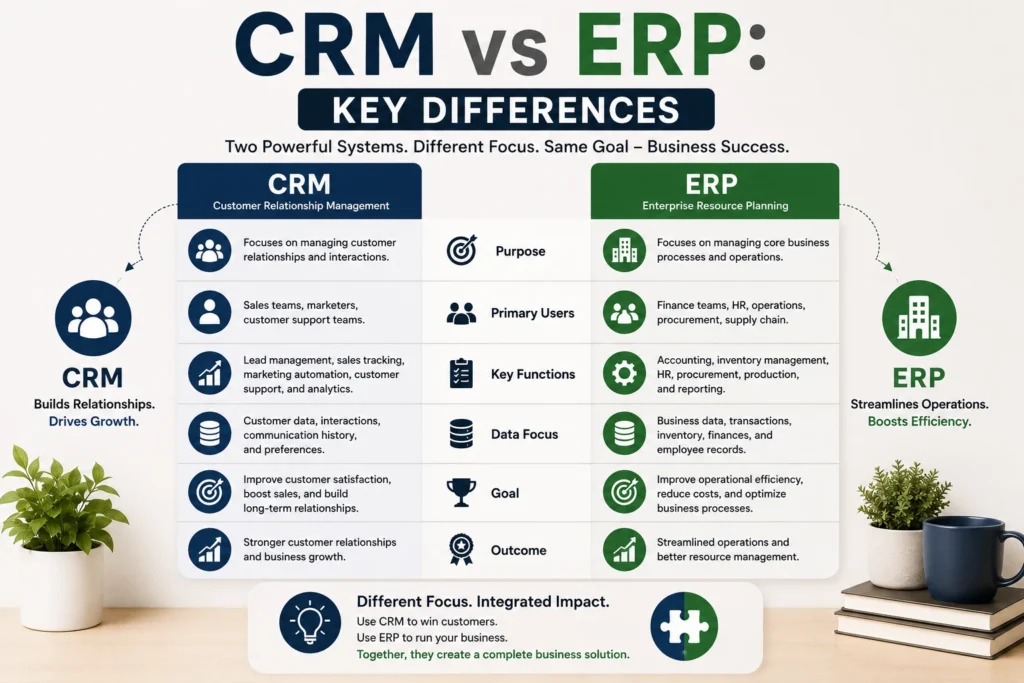
The biggest difference between CRM and ERP lies in their primary focus. CRM is designed to help businesses manage customer interactions, improve sales performance, and strengthen customer relationships. ERP focuses on optimizing internal processes and improving operational efficiency across multiple departments. CRM users typically include sales, marketing, and customer support teams, while ERP users often work in finance, operations, inventory management, procurement, and human resources. Another key difference is the type of data each system manages. CRM stores customer-related information, whereas ERP handles operational and financial data that support day-to-day business functions.
💚 You might also like: Schedow 2026: A Practical Guide to Modern Scheduling
CRM vs ERP Comparison Table
| Feature | CRM | ERP |
| Primary Focus | Customer Relationships | Business Operations |
| Main Users | Sales, Marketing, Support | Finance, HR, Operations |
| Key Goal | Increase Revenue and Retention | Improve Efficiency and Productivity |
| Data Type | Customer Data | Operational and Financial Data |
| Core Functions | Lead Management, Sales Tracking | Inventory, Finance, Supply Chain |
| Business Impact | Better Customer Experience | Better Operational Control |
| Ideal For | Customer-Centric Businesses | Operationally Complex Organizations |
| Integration Potential | Works with ERP Systems | Works with CRM Systems |
This comparison highlights that CRM and ERP are not competing technologies. Instead, they solve different business challenges and often deliver the best results when used together as part of a connected business ecosystem.
Advantages and Disadvantages of CRM and ERP
Both CRM and ERP systems offer significant benefits, but they also come with challenges that businesses should consider before implementation. CRM platforms help increase sales productivity, improve customer satisfaction, and provide better visibility into customer interactions. However, CRM success depends heavily on user adoption and data quality. ERP systems improve operational efficiency, automate processes, and provide a unified view of business performance. The downside is that ERP implementations can be complex, time-consuming, and more expensive than CRM deployments. Evaluating both benefits and limitations helps organizations make informed technology decisions that support their long-term goals.
CRM vs ERP: Which Solution Is Right for Your Business?
Choosing between CRM and ERP depends on your organization’s priorities, operational structure, and growth stage. Businesses focused on customer acquisition, sales growth, and customer retention often benefit more from CRM software. Organizations dealing with complex operations, inventory management, financial reporting, or supply chain coordination typically gain greater value from ERP systems. Many growing companies eventually require both solutions because customer-facing and operational processes become increasingly interconnected. Rather than asking which system is universally better, businesses should evaluate which challenges need immediate attention and which platform will deliver the highest return on investment.
When to Choose a CRM
A CRM system is the right choice when improving customer relationships and increasing revenue are your top priorities. Businesses that struggle with lead tracking, sales pipeline visibility, customer communication, or marketing performance can benefit significantly from CRM software. It helps sales teams manage opportunities more effectively while giving marketing and customer service teams access to valuable customer insights. CRM is often the first major business software investment for startups and small businesses because it directly supports growth and customer acquisition efforts.
When to Choose an ERP
An ERP system becomes essential when operational complexity begins slowing business performance. If departments operate using disconnected software, spreadsheets, or manual processes, ERP can help centralize information and improve efficiency. Organizations dealing with inventory challenges, financial reporting issues, supply chain management, or workforce coordination often gain immediate value from ERP implementation. ERP is particularly beneficial for manufacturers, distributors, retailers, and larger organizations that require accurate, real-time visibility into business operations across multiple departments.
When to Use Both
For many organizations, the best solution is not choosing between CRM and ERP but combining both systems. CRM manages customer interactions and sales activities, while ERP handles operational and financial processes. Together, they create a complete view of the customer journey, from initial contact to order fulfillment and ongoing support. Integration between CRM and ERP eliminates data silos, improves collaboration between departments, and enables more informed decision-making. Businesses seeking long-term scalability often find that using both systems provides the strongest foundation for sustainable growth.
Integrating CRM and ERP Systems
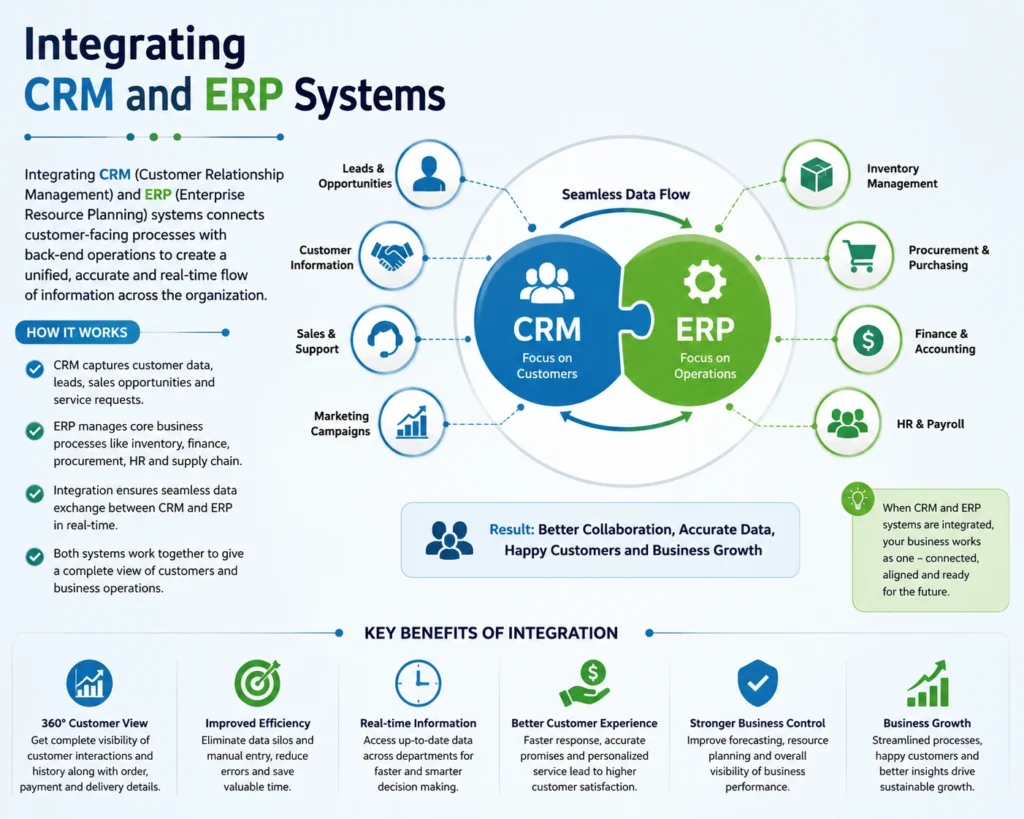
As businesses grow, customer-facing activities and internal operations become increasingly connected. This is where CRM and ERP integration delivers significant value. By connecting both systems, organizations can create a seamless flow of information between departments. Sales teams gain visibility into inventory levels and order status, while operations teams can access customer information when processing orders or resolving issues. Integration eliminates duplicate data entry, reduces errors, and improves collaboration across the organization. Businesses that successfully integrate CRM and ERP often experience faster decision-making, greater operational efficiency, and a more consistent customer experience throughout the entire customer lifecycle.
💚 You might also like: Best Free AI Tools for Image Generation (2026)
CRM vs ERP: Cost and Implementation
The cost of CRM and ERP systems varies significantly depending on business size, required features, customization needs, and deployment model. CRM solutions are generally more affordable and faster to implement, making them a popular choice for small and medium-sized businesses. ERP systems typically require a larger investment because they manage multiple business functions and often involve more complex implementation processes. Additional costs may include employee training, data migration, customization, maintenance, and integration services. While ERP often requires a higher upfront investment, both CRM and ERP can generate substantial long-term returns through improved efficiency, productivity, and business performance.
Frequently Asked Questions
What Is the Difference Between CRM and ERP?
CRM is designed to handle customer interactions, sales processes, and marketing efforts. ERP focuses on managing internal business operations like finance, inventory, and HR.
Can CRM and ERP Be Integrated?
Yes, CRM and ERP systems can be integrated to share data between departments. This improves efficiency, accuracy, and decision-making across the business.
Which Is More Expensive, CRM or ERP?
ERP systems are usually more expensive due to their complexity and wide functionality. CRM systems are generally more affordable and easier to implement.
Should Small Businesses Use CRM or ERP?
Small businesses often begin with a CRM system to organize customer data and support sales activities. ERP becomes useful later when operations and processes become more complex.
Conclusion
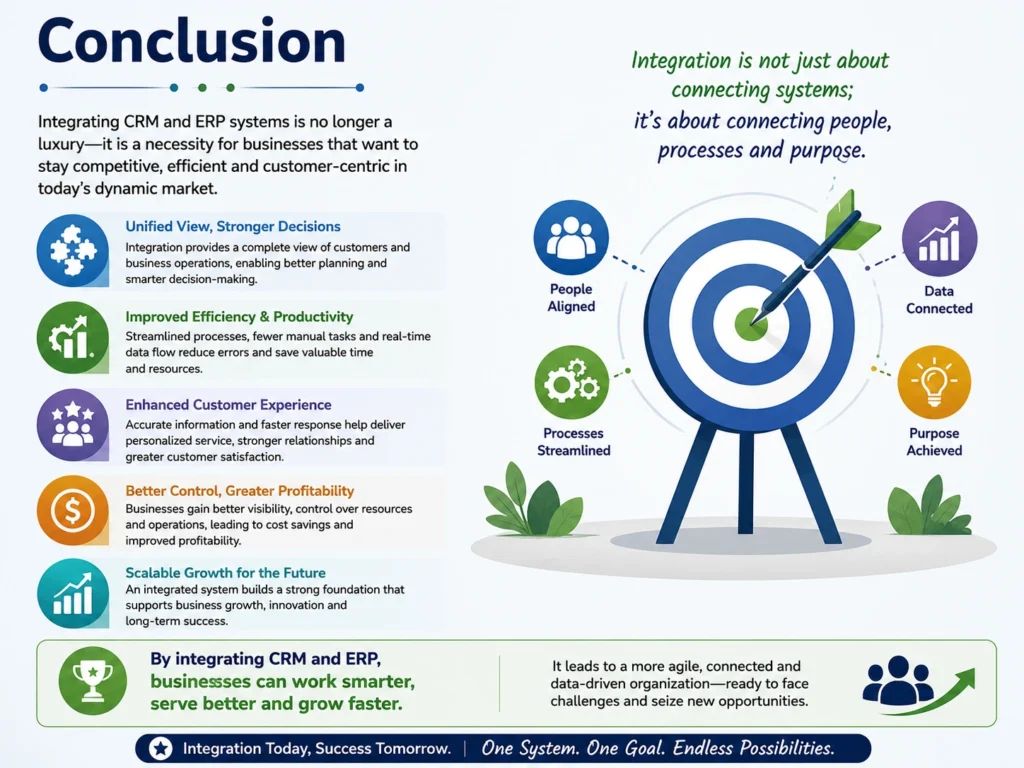
CRM and ERP systems play different but equally important roles in modern business operations. CRM focuses on building stronger customer relationships, improving sales performance, and enhancing customer experiences. ERP concentrates on streamlining internal processes, managing resources, and improving operational efficiency. Rather than viewing CRM and ERP as competing solutions, businesses should recognize that they solve different challenges. The right choice depends on your organization’s goals, priorities, and stage of growth. For many companies, combining CRM and ERP creates a powerful technology ecosystem that supports both customer success and operational excellence, providing a strong foundation for sustainable business growth.
✨ Want bite-sized tech wisdom? Follow Tech Baaz.