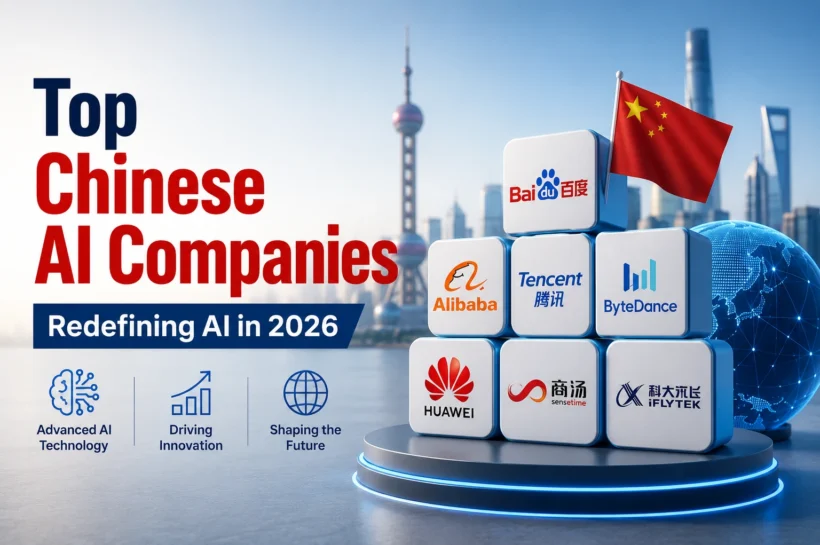

Top Chinese AI Companies Redefining AI in 2026
Artificial intelligence is transforming industries worldwide, and China has become one of the biggest forces behind this technological revolution. From powerful large language models (LLMs) to autonomous driving, robotics, healthcare, and smart cities, Chinese AI companies are developing innovative solutions that compete with some of the world’s biggest technology brands.
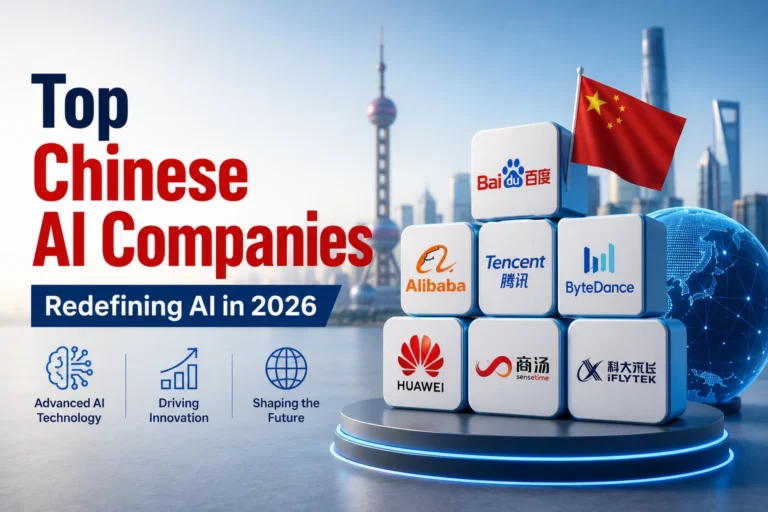
In 2026, China’s AI ecosystem includes both established tech giants and fast-growing startups. Companies such as DeepSeek, Baidu, Alibaba, Tencent, and Huawei continue investing billions into AI research, while newer startups are introducing advanced language models that are gaining attention across global markets.
This guide explores the top Chinese AI companies to watch in 2026, compares their strengths, highlights the industries they serve, and explains how they are shaping the future of artificial intelligence.
Why Chinese AI Companies Are Growing Fast
Chinese AI companies have experienced remarkable growth because they combine strong government support, massive technology investments, and access to one of the world’s largest digital markets. Businesses across China are rapidly adopting AI to improve productivity, automate operations, and deliver smarter customer experiences. At the same time, local universities produce thousands of AI researchers every year, creating a steady pipeline of talent. The combination of cloud computing, advanced chip development, and increasing enterprise demand allows Chinese AI companies to innovate quickly while competing with leading international AI developers.
How We Chose the Top Chinese AI Companies
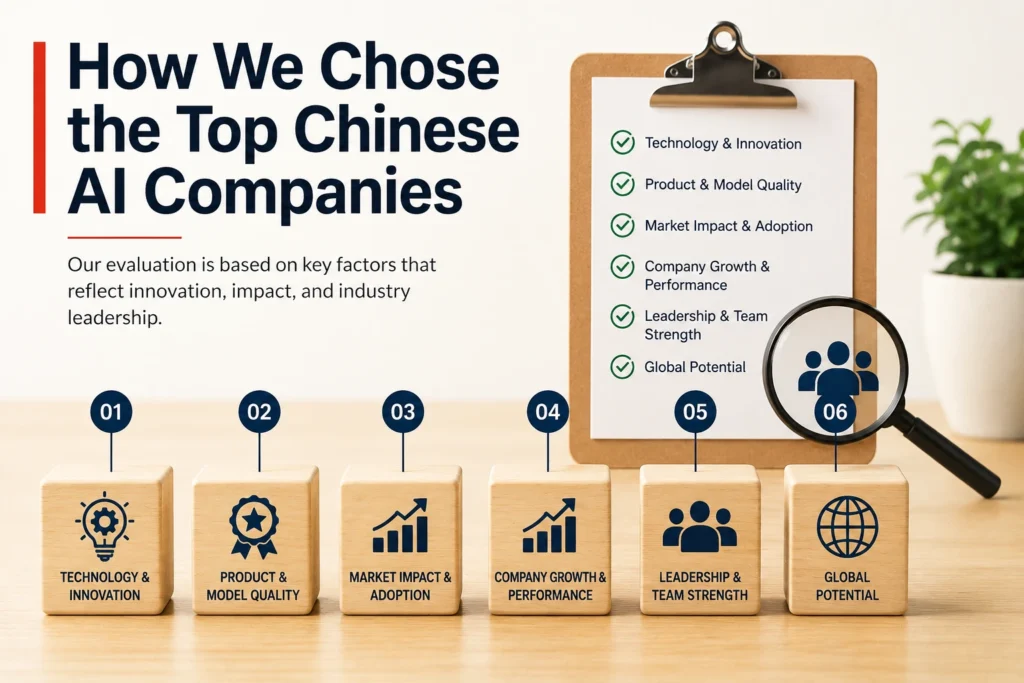
Selecting the best Chinese AI companies requires looking beyond popularity alone. We evaluated each company based on AI innovation, research capabilities, commercial success, industry adoption, funding, open-source contributions, and real-world applications. We also considered the performance of their AI models, enterprise solutions, developer ecosystems, and global influence. This balanced approach highlights companies that are not only leading today’s AI market but are also positioned to shape the future of artificial intelligence over the next several years.
💚 You might also like: BYD vs Tesla: Which EV Is Better? (2026 Comparison Guide)
DeepSeek
DeepSeek has rapidly become one of China’s most recognized AI startups thanks to its high-performance large language models and strong focus on open-source development. Its AI models deliver advanced reasoning, coding assistance, multilingual support, and research capabilities while maintaining competitive operating costs. DeepSeek’s growing developer community and enterprise adoption have made it one of the most influential AI companies to watch in 2026.
Zhipu AI
Zhipu AI specializes in foundation models designed for enterprise applications, research, and intelligent assistants. Its GLM family of language models supports natural language understanding, document analysis, and AI-powered business automation. By working closely with universities and commercial partners, Zhipu AI continues expanding its presence across education, finance, healthcare, and government sectors.
Moonshot AI
Moonshot AI focuses on developing advanced conversational AI systems capable of handling long-context reasoning and complex knowledge tasks. Its flagship language models are designed to improve productivity by assisting with writing, research, coding, and information retrieval. Continuous improvements in model efficiency have helped Moonshot AI attract both enterprise customers and everyday users.
MiniMax
MiniMax develops multimodal AI models capable of understanding and generating text, images, speech, and other media. The company emphasizes natural conversations and interactive AI experiences, making its technology useful for digital assistants, gaming, entertainment, and customer service. Its versatile AI platform continues gaining popularity among businesses seeking intelligent automation.
Baichuan AI
Baichuan AI is known for creating large language models optimized for commercial deployment across multiple industries. The company invests heavily in AI research while offering enterprise-ready solutions for finance, healthcare, education, and business intelligence. Its focus on model reliability, scalability, and multilingual capabilities has strengthened its position in China’s competitive AI landscape.
01.AI
Founded with the goal of advancing open-source artificial intelligence, 01.AI develops efficient foundation models that businesses can customize for specialized applications. The company prioritizes practical AI deployment by helping organizations build intelligent workflows, automate operations, and reduce development costs through accessible AI technologies.
StepFun
StepFun is an emerging AI startup concentrating on next-generation foundation models and intelligent assistants. The company aims to improve reasoning abilities, multimodal understanding, and enterprise productivity through advanced AI systems. Although relatively new, StepFun has attracted significant attention due to its rapid innovation and growing investment within China’s expanding AI ecosystem.
Leading Chinese AI Tech Companies
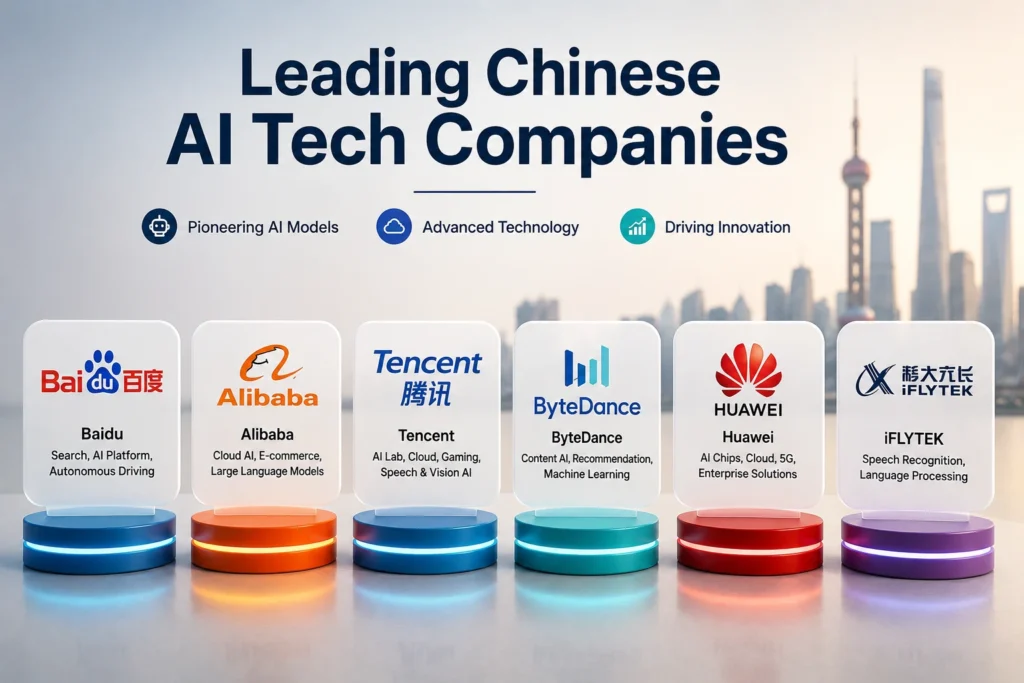
Baidu (ERNIE)
Baidu has transformed from China’s leading search engine into one of the country’s biggest AI innovators. Its ERNIE family of large language models powers intelligent search, enterprise AI services, cloud computing, and conversational assistants. Baidu also invests heavily in autonomous driving through its Apollo platform, making it a leader in both generative AI and self-driving technology. With strong research capabilities and years of AI development experience, Baidu remains one of the most influential Chinese AI companies in 2026.
Alibaba (Qwen)
Alibaba has become a major player in artificial intelligence through its Qwen large language models and Alibaba Cloud AI services. Qwen supports multilingual conversations, coding assistance, content generation, and enterprise automation. Businesses use Alibaba’s AI tools to improve customer service, e-commerce recommendations, and business analytics. The company’s cloud infrastructure enables developers to deploy powerful AI applications at scale, helping Alibaba strengthen its position in both domestic and international AI markets.
Tencent (Hunyuan)
Tencent’s Hunyuan AI model supports a wide range of services across social media, gaming, cloud computing, and enterprise software. The company integrates AI into products like WeChat, online advertising, digital entertainment, and financial services. Tencent continues expanding its AI research while improving multimodal capabilities that combine text, images, speech, and video generation. Its extensive user base provides valuable real-world insights that help continuously improve its AI models.
Huawei AI
Huawei has built a comprehensive AI ecosystem that combines AI chips, cloud computing, enterprise software, and intelligent devices. Through its Ascend AI processors and ModelArts development platform, Huawei helps businesses build and deploy AI solutions efficiently. The company also integrates AI into telecommunications, manufacturing, healthcare, and smart city infrastructure. Huawei’s focus on AI hardware and software makes it one of China’s most complete AI technology providers.
ByteDance (Doubao)
ByteDance has rapidly expanded beyond social media by developing Doubao, a powerful AI assistant based on advanced language models. Doubao offers writing assistance, translation, research support, coding help, and conversational AI capabilities. ByteDance also applies AI throughout TikTok, content recommendations, advertising systems, and creative tools. Its expertise in recommendation algorithms gives the company a unique advantage in developing personalized AI experiences.
SenseTime
SenseTime is internationally recognized for its expertise in computer vision, facial recognition, and deep learning technologies. The company provides AI solutions for healthcare, finance, education, transportation, retail, and smart cities. In recent years, SenseTime has expanded into generative AI by launching its own large language models alongside its established computer vision products, making it one of China’s most diversified AI companies.
Megvii
Megvii specializes in computer vision, image recognition, robotics, and intelligent logistics. Its AI solutions help businesses automate warehouse operations, manufacturing processes, and security systems. The company also develops AI-powered robotics that improve industrial efficiency through automation. Megvii’s expertise in visual intelligence continues making it an important player in China’s AI ecosystem.
iFlytek
iFlytek is a leading provider of speech recognition and natural language processing technologies. Its AI products support voice assistants, real-time translation, education platforms, healthcare applications, and smart office solutions. The company has spent years improving speech synthesis and multilingual voice technology, making it one of China’s strongest AI companies in voice intelligence and conversational AI.
Top Chinese AI Companies Comparison
| Company | Primary AI Focus | Key Products | Best For |
| DeepSeek | Large Language Models | DeepSeek LLM | Coding, research, open-source AI |
| Zhipu AI | Enterprise AI | GLM Models | Business automation |
| Moonshot AI | Long-context AI | Kimi AI | Productivity and research |
| MiniMax | Multimodal AI | AI Assistant | Interactive AI experiences |
| Baichuan AI | Enterprise LLMs | Baichuan Models | Commercial AI deployment |
| 01.AI | Open-source AI | Yi Models | Developers and businesses |
| StepFun | Foundation Models | AI Assistant | Emerging enterprise AI |
| Baidu | Search & LLM | ERNIE, Apollo | Search, cloud, autonomous driving |
| Alibaba | Cloud AI | Qwen | Enterprise AI and cloud computing |
| Tencent | Multimodal AI | Hunyuan | Social media and enterprise services |
| Huawei | AI Infrastructure | Ascend AI, ModelArts | AI hardware and enterprise solutions |
| ByteDance | Consumer AI | Doubao | AI assistants and content creation |
| SenseTime | Computer Vision | SenseNova | Smart cities and vision AI |
| Megvii | Computer Vision | Face++ | Robotics and logistics |
| iFlytek | Speech AI | Spark Model | Voice recognition and education |
Industries Using Chinese AI
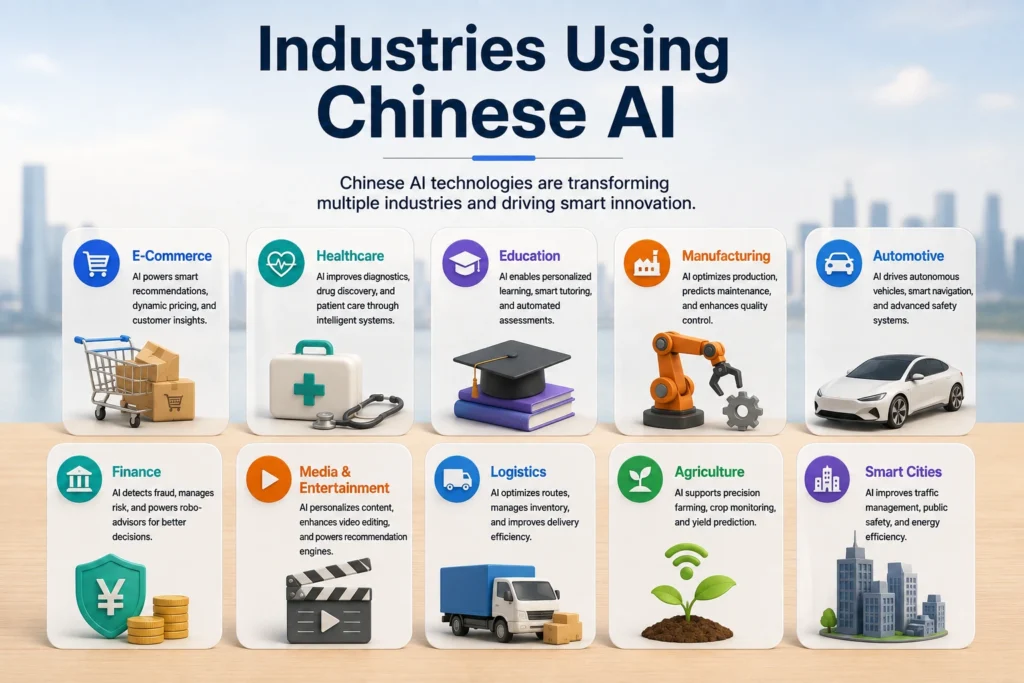
Chinese AI companies are transforming industries by improving efficiency, automating repetitive tasks, and enabling smarter decision-making. Their technologies now support everything from virtual assistants and intelligent healthcare systems to autonomous vehicles and advanced manufacturing. As AI adoption accelerates, businesses across multiple sectors are integrating Chinese AI solutions into daily operations to remain competitive and improve customer experiences.
💚 You might also like: Best Chinese Smartphones in 2026: Top 10 Picks Compared
Generative AI and Large Language Models
Generative AI has become one of the fastest-growing segments of China’s AI industry. Companies like DeepSeek, Alibaba, Baidu, and Zhipu AI develop powerful language models capable of writing content, generating code, translating languages, summarizing documents, and powering intelligent chatbots. These AI systems help businesses automate workflows while improving productivity for developers, marketers, researchers, and customer support teams.
Computer Vision and Smart Cities
Computer vision technologies are widely used across transportation, public safety, retail, manufacturing, and urban infrastructure. Companies such as SenseTime, Megvii, and Huawei develop AI systems that analyze images, recognize objects, monitor traffic, and optimize city management. These technologies support smart surveillance, automated quality inspection, facial recognition, and intelligent traffic control, making urban environments more efficient and connected.
Healthcare, Robotics, and Self-Driving Cars
Chinese AI companies are also driving innovation in healthcare, industrial robotics, and autonomous transportation. AI-powered medical imaging helps doctors detect diseases earlier, while robotic automation improves manufacturing efficiency and warehouse operations. Companies like Baidu, Huawei, and Megvii continue investing in autonomous driving technologies, intelligent robotics, and AI-assisted healthcare solutions that are expected to play an even larger role in the coming years.
Chinese AI Companies vs Global AI Companies
Chinese AI companies are rapidly emerging as strong competitors to global AI leaders through advanced language models, multimodal technologies, cloud platforms, and enterprise AI solutions. While companies such as OpenAI, Anthropic, Google DeepMind, and Meta remain influential worldwide, Chinese firms have made significant progress through rapid innovation, large-scale investments, and expanding commercial adoption. Although each ecosystem has unique strengths, the competition is accelerating the pace of AI development across the globe.
| Feature | Chinese AI Companies | Global AI Companies |
| Primary Focus | Enterprise AI, cloud services, smart cities | General AI, enterprise, consumer AI |
| Leading Models | DeepSeek, Qwen, ERNIE, Hunyuan | GPT, Claude, Gemini, Llama |
| Open-Source Support | Strong and growing | Strong among selected companies |
| Major Industries | Manufacturing, finance, healthcare, retail | Technology, education, business, research |
| Cloud Integration | Extensive | Extensive |
| AI Hardware | Growing rapidly | Well-established |
| Global Availability | Expanding internationally | Widely available worldwide |
The Future of Chinese AI Companies
The future of Chinese AI companies looks promising as investment, research, and enterprise adoption continue to grow. More businesses are integrating AI into customer service, software development, manufacturing, education, and healthcare. At the same time, Chinese companies are improving their large language models with stronger reasoning, multimodal capabilities, and lower operating costs. Increased collaboration between AI developers, cloud providers, and hardware manufacturers is expected to accelerate innovation even further. As AI regulations become clearer and international adoption expands, China’s AI ecosystem is likely to play an even larger role in shaping the future of artificial intelligence worldwide.
Challenges Chinese AI Companies Face
Despite their rapid progress, Chinese AI companies also face several challenges. International competition continues to intensify as global AI leaders release more advanced models and services. Export restrictions on advanced semiconductor technology create additional pressure on AI hardware development. Companies must also address regulatory compliance, cybersecurity concerns, data privacy requirements, and responsible AI practices. Maintaining innovation while balancing government regulations and expanding into global markets remains one of the industry’s biggest long-term challenges.
Frequently Asked Questions
Which is the best Chinese AI company?
There isn’t a single best company for every use case. DeepSeek is widely recognized for open-source language models, while Baidu, Alibaba, Tencent, and Huawei lead in enterprise AI, cloud computing, and large-scale commercial applications.
Is DeepSeek better than ChatGPT?
DeepSeek performs exceptionally well in coding, reasoning, and open-source AI development, while ChatGPT offers broader global availability, extensive integrations, and a mature ecosystem. The better choice depends on your specific needs and preferred features.
Which Chinese AI companies have open-source AI models?
Several Chinese AI companies actively support open-source AI development, including DeepSeek, Alibaba (Qwen), Baichuan AI, and 01.AI. Their publicly available models allow developers and businesses to build customized AI applications.
Can people outside China use these AI tools?
Yes. Many Chinese AI platforms provide international access through websites, APIs, cloud services, or open-source model releases. However, availability, supported languages, and regional features may vary depending on the company and local regulations.
Conclusion
Chinese AI companies are becoming major innovators in artificial intelligence by combining advanced research, powerful language models, cloud computing, and real-world business applications. From emerging startups like DeepSeek and Moonshot AI to established technology giants such as Baidu, Alibaba, Tencent, and Huawei, these organizations are driving rapid progress across industries. As AI adoption continues to grow worldwide, Chinese AI companies are expected to remain key contributors to the next generation of intelligent technologies, making them well worth watching throughout 2026 and beyond.
✨ Want bite-sized tech wisdom? Follow Tech Baaz.