
China’s Humanoid Robots Explained: AI, Innovation & Robotics Updates
Artificial intelligence is changing the future of robotics, and China is quickly becoming one of the biggest innovators in this space. Instead of building robots only for research labs, Chinese companies are creating humanoid robots that can work in factories, warehouses, hospitals, retail stores, and even homes. These intelligent machines are designed to perform tasks that require human-like movement, communication, and decision-making. Backed by advanced AI, a powerful manufacturing ecosystem, and continuous investment, China’s robotics industry is growing at an impressive pace. Industry reports show Chinese manufacturers now account for most global humanoid robot shipments, highlighting how rapidly the country is moving from prototypes to real-world deployment.
In this guide, you’ll learn what China’s humanoid robots are, why the country is leading this fast-growing industry, how these robots actually work, which companies are driving innovation, and what the future may look like. Whether you’re new to robotics or already following AI trends, this article explains everything in a simple, engaging, and practical way.
What Are China’s Humanoid Robots?
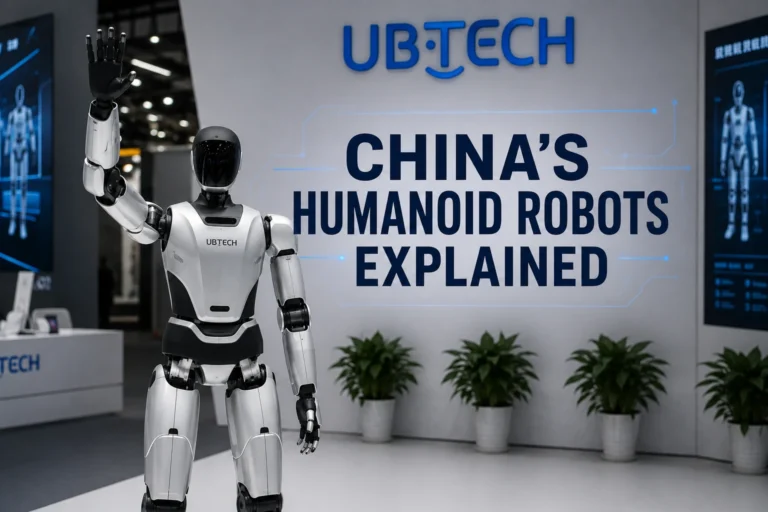
China’s humanoid robots are advanced machines built to resemble the human body and perform tasks that normally require human movement, coordination, and intelligence. Unlike traditional industrial robots that stay in one location and repeat the same motion, humanoid robots are designed to walk, balance, recognize objects, communicate with people, and adapt to changing environments. They combine artificial intelligence, computer vision, sensors, powerful processors, and precision mechanics to operate safely in places designed for humans. As Chinese companies continue improving these technologies, humanoid robots are becoming practical solutions for manufacturing, logistics, healthcare, education, research, and customer service rather than remaining experimental machines.
Why Is China Leading the Humanoid Robot Industry?
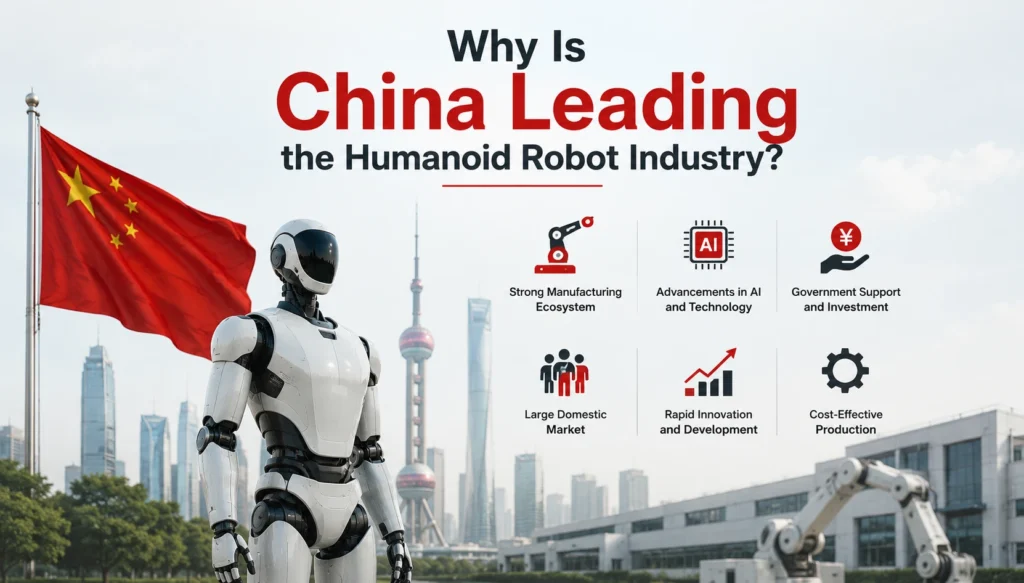
China has become a global leader in humanoid robotics because it combines advanced manufacturing, artificial intelligence, government support, and a highly efficient supply chain. Companies can develop new robot models faster since many essential components, including batteries, motors, sensors, and actuators, are produced domestically. At the same time, major investments in AI research help robots become smarter and more capable every year. According to recent industry reports, Chinese manufacturers dominate global humanoid robot shipments, while companies such as AgiBot, Unitree, and UBTECH continue expanding commercial production faster than many international competitors.
💚 You might also like: Top Chinese AI Companies Redefining AI in 2026
How China’s Humanoid Robots Work
Modern humanoid robots operate through a combination of intelligent software and advanced mechanical systems. Every movement begins with cameras and sensors collecting information from the surrounding environment. Artificial intelligence analyzes that information, makes decisions in real time, and sends commands to motors that control movement. At the same time, onboard processors manage balance, navigation, and obstacle detection while battery systems provide continuous power. Instead of relying on a single technology, these robots combine multiple systems that work together simultaneously, allowing them to complete tasks with greater accuracy, flexibility, and human-like behavior.
AI Systems and Decision-Making
Artificial intelligence is the core technology behind every humanoid robot. It processes visual information, understands voice commands, recognizes objects, and determines the best action for each situation. Modern Chinese robots increasingly use multimodal AI and embodied intelligence, enabling them to learn from experience instead of relying only on fixed programming. This allows robots to improve performance over time, respond more naturally to people, and complete complex tasks with greater efficiency in dynamic environments.
Cameras, LiDAR, and Vision Technology
Humanoid robots rely on advanced vision systems to understand their surroundings. High-resolution cameras capture images, while LiDAR and depth sensors measure distance and create detailed three-dimensional maps. Computer vision software analyzes this information to identify people, recognize objects, detect obstacles, and navigate safely. These technologies are especially valuable in factories and warehouses, where robots must move accurately while avoiding collisions and interacting with constantly changing environments.
Sensors and Environmental Awareness
Environmental awareness depends on dozens of sensors working together throughout the robot’s body. Force sensors measure pressure during lifting, gyroscopes maintain balance while walking, accelerometers detect movement, and touch sensors improve object handling. These components continuously send data to the robot’s AI system, allowing it to adjust posture, walking speed, grip strength, and body position within milliseconds. This real-time feedback helps humanoid robots perform tasks more safely and naturally around people.
Motors, Joints, and Movement
Human-like movement is made possible through electric actuators, precision motors, and multiple articulated joints. Motion control software coordinates every movement to maintain stability while walking, climbing stairs, lifting objects, or turning. Each joint receives hundreds of tiny adjustments every second, allowing the robot to move smoothly without losing balance. Recent improvements in actuator technology have significantly increased the flexibility, speed, and accuracy of Chinese humanoid robots used in commercial environments.
Batteries and Power Management
Every humanoid robot depends on efficient power management to maintain reliable performance throughout the day. Most Chinese models use high-density lithium battery packs combined with intelligent energy management systems that distribute electricity across processors, cameras, sensors, and motors. Efficient power control reduces unnecessary energy consumption while extending operating time between charges. Manufacturers are also developing faster charging technologies and more energy-efficient hardware to make humanoid robots suitable for longer industrial shifts and everyday commercial use.
Top Humanoid Robot Companies in China
China’s humanoid robot industry is powered by a mix of established robotics companies and fast-growing startups, each bringing unique innovations to the market. Some focus on affordable robots for research and education, while others develop advanced humanoid systems for manufacturing, logistics, and commercial services. Their ongoing advancements in artificial intelligence, precision engineering, and motion control have fueled innovation and reinforced China’s leadership in the global robotics industry. As competition increases, these companies are not only improving robot performance but also reducing production costs, making humanoid robots more practical for businesses across different industries.
Unitree Robotics
Unitree Robotics is one of China’s most recognized robotics companies, known for developing agile robots with advanced mobility and competitive pricing. After gaining worldwide attention with its quadruped robots, the company expanded into humanoid robotics by focusing on balance, natural movement, and AI-powered interaction. Unitree designs robots for research, industrial automation, and commercial applications, while continuously improving walking stability, motion control, and intelligent navigation to support more practical real-world use cases.
UBTECH Robotics
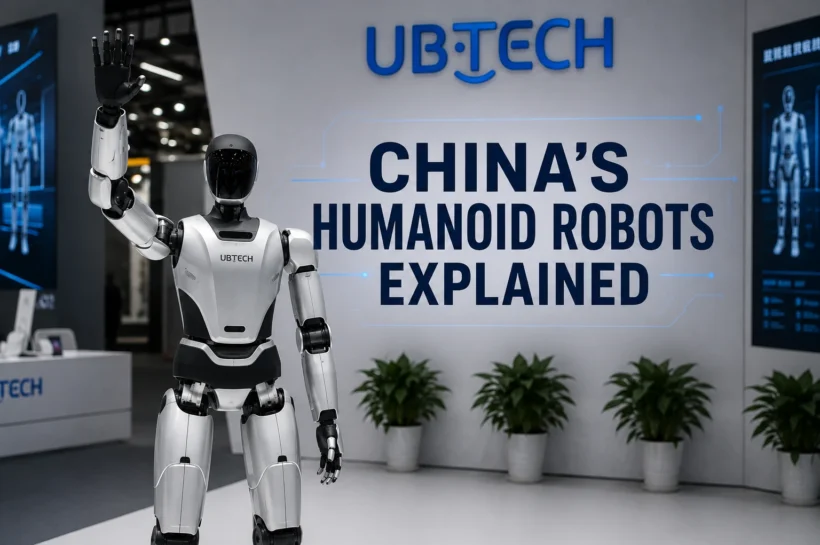
UBTECH Robotics has built a strong reputation by combining artificial intelligence with humanoid robotics for commercial and educational environments. The company develops robots capable of communication, object recognition, and autonomous navigation, making them suitable for customer service, education, healthcare, and industrial applications. Through continuous AI research and partnerships with major manufacturers, UBTECH is helping accelerate the adoption of humanoid robots across multiple industries while expanding its global presence.
AgiBot
AgiBot is one of China’s fastest-growing humanoid robotics companies, focusing on embodied AI and intelligent automation. Its robots are designed to understand their surroundings, interact naturally with people, and perform complex physical tasks with minimal human guidance. By combining advanced AI models with precision hardware, AgiBot aims to create adaptable robots capable of supporting manufacturing, logistics, research, and future household applications where flexible decision-making is essential.
EngineAI
EngineAI focuses on developing humanoid robots with realistic movement, advanced balance, and efficient motion control. The company’s engineering approach emphasizes flexible joints, intelligent locomotion, and stable walking performance, allowing robots to operate safely in dynamic environments. EngineAI continues to improve its robotics platform through AI integration and mechanical innovation, supporting applications in research, industrial automation, and commercial service industries.
Fourier Intelligence
Fourier Intelligence originally gained recognition for rehabilitation technology before expanding into humanoid robotics. The company combines expertise in healthcare engineering with artificial intelligence to develop robots capable of assisting both medical professionals and industrial users. Its humanoid platforms are designed with precise motion control, human-centered interaction, and adaptable software, making them suitable for rehabilitation, research, smart manufacturing, and other environments where safe human-robot collaboration is important.
Common Uses of China’s Humanoid Robots
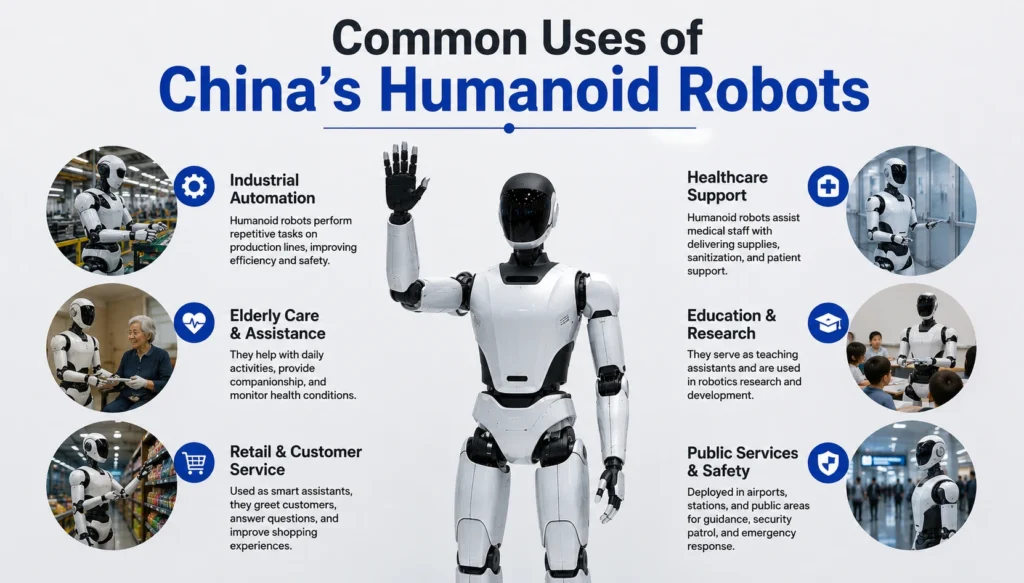
China’s humanoid robots are no longer limited to laboratories or technology exhibitions. They are gradually becoming part of real business operations where they improve efficiency, reduce repetitive work, and support human employees. Their ability to walk, understand instructions, recognize objects, and interact with people makes them suitable for industries that require both physical movement and intelligent decision-making. As artificial intelligence continues to advance, companies are discovering new ways to use humanoid robots in everyday operations across manufacturing, healthcare, logistics, education, and customer-facing services.
Manufacturing and Factory Automation
Factories remain one of the largest markets for humanoid robots. These machines can transport materials, inspect products, operate equipment, and perform repetitive assembly tasks with consistent accuracy. By working alongside human employees, they help increase productivity while reducing physical strain and workplace injuries. Their flexibility also allows manufacturers to adapt production lines more quickly when product requirements change.
Healthcare and Elderly Care
Healthcare providers are exploring humanoid robots to assist with routine responsibilities that support medical staff rather than replace them. Robots can deliver supplies, guide visitors, monitor patients, and provide basic companionship for older adults. In rehabilitation settings, they may also assist therapists by demonstrating exercises or helping patients complete repetitive physical movements under professional supervision, improving efficiency while maintaining personalized care.
Warehousing and Logistics
Warehouses require continuous movement, lifting, sorting, and transportation of goods, making them an ideal environment for humanoid robots. Equipped with computer vision and intelligent navigation systems, these robots can identify packages, transport inventory, and organize storage areas with minimal supervision. Their ability to work around people safely makes them valuable for modern logistics centers that demand greater speed and operational efficiency.
Retail and Customer Service
Retail businesses are beginning to use humanoid robots as interactive assistants that greet customers, answer common questions, provide directions, and recommend products. Unlike traditional kiosks, humanoid robots interact with customers through natural conversations, facial expressions, and gestures, creating a more engaging and personalized experience. They can also support employees by handling repetitive inquiries, allowing staff to focus on more personalized customer interactions.
Education and Research
Educational institutions and research organizations use humanoid robots to study artificial intelligence, robotics engineering, and human-robot interaction. Students gain practical experience by programming robot behavior, testing navigation systems, and developing new AI applications. Researchers also use these platforms to explore machine learning, autonomous decision-making, and embodied intelligence, helping drive future innovations in robotics technology.
Comparing China’s Leading Humanoid Robots
As China’s humanoid robot industry continues to grow, businesses, researchers, and technology enthusiasts are increasingly comparing different robot models before making investment or research decisions. Every humanoid robot is designed to perform human-like tasks, they differ significantly in artificial intelligence, movement, battery efficiency, payload capacity, pricing, and commercial applications. And ome models are optimized for factory automation, while others are better suited for healthcare, research, or AI development. Understanding these differences helps readers identify which robot delivers the best value for a specific purpose. The comparison below highlights the key specifications and strengths of China’s leading humanoid robots, making it easier to evaluate their real-world capabilities.
Comparison of China’s Leading Humanoid Robots
| Robot Model | Company | Estimated Price | AI Capabilities | Battery Life | Walking Speed | Payload Capacity | Best Use Cases |
| Unitree G1 | Unitree Robotics | Starting at ~$16,000 | Multimodal AI, voice commands, autonomous navigation, motion learning | Up to 2 hours | Up to 2 m/s | Around 3 kg | AI research, universities, software development, robotics testing |
| Walker S2 | UBTECH Robotics | Enterprise Pricing | Industrial AI, object recognition, autonomous task execution | Around 2 hours | ~1.5 m/s | Up to 15 kg | Smart factories, industrial automation, manufacturing |
| A2 | AgiBot | Not Publicly Disclosed | Embodied AI, natural language interaction, adaptive learning | Around 2 hours | ~1.3 m/s | Around 5 kg | Logistics, commercial AI, warehouse operations |
| PM01 | EngineAI | Enterprise Pricing | Intelligent navigation, balance control, autonomous movement | Around 2 hours | Up to 2 m/s | Around 5 kg | Robotics research, AI testing, industrial environments |
| GR-2 | Fourier Intelligence | Enterprise Pricing | AI-assisted interaction, rehabilitation intelligence, autonomous mobility | Around 2 hours | ~1.2 m/s | Around 5 kg | Healthcare, rehabilitation, medical research |
Challenges Facing China’s Humanoid Robot Industry
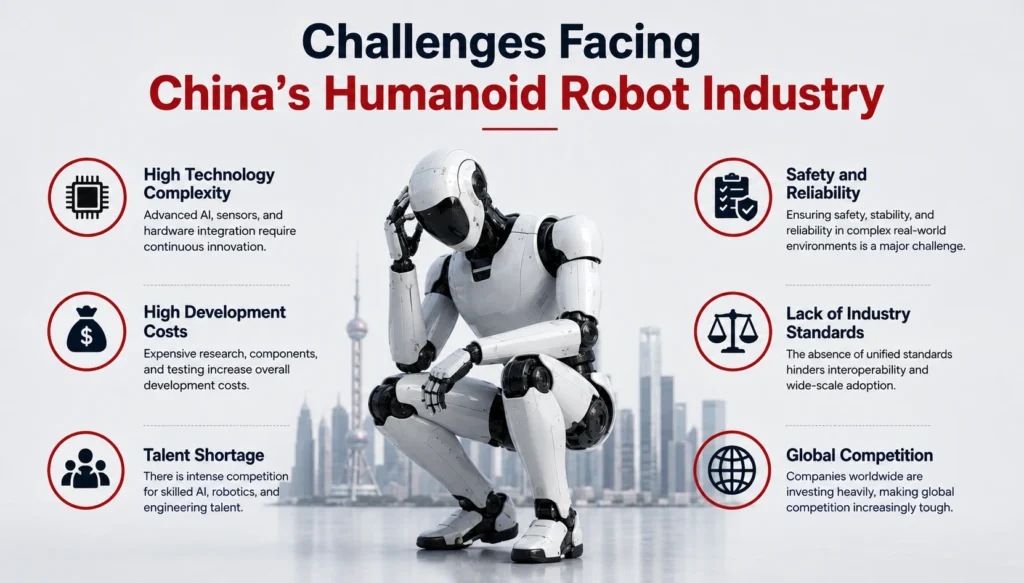
Despite remarkable progress, China’s humanoid robot industry still faces several technical and commercial challenges before these machines become part of everyday life. While artificial intelligence and robotics continue to improve, manufacturers must overcome issues related to cost, battery efficiency, hardware reliability, and public acceptance. Competition from global robotics companies is also increasing, pushing Chinese developers to innovate faster while maintaining affordable pricing. Overcoming these challenges will be key to accelerating commercial adoption and enabling humanoid robots to perform safely, efficiently, and reliably across diverse industries.
💚 You might also like: BYD vs Tesla: Which EV Is Better? (2026 Comparison Guide)
High Development Costs
Designing a humanoid robot requires significant investment in research, engineering, software development, and advanced hardware. High-quality actuators, AI processors, sensors, and precision components increase production expenses, making commercial robots costly to manufacture. Although prices are gradually decreasing as production scales, many businesses still view humanoid robots as a long-term investment rather than an immediate replacement for traditional automation systems.
Battery and Hardware Limitations
Battery technology remains one of the biggest obstacles in humanoid robotics. Most robots can only operate for a limited number of hours before requiring a recharge, reducing productivity during continuous operations. Engineers are also working to improve actuator durability, heat management, and overall hardware reliability. Longer battery life and stronger mechanical components will play a major role in making humanoid robots practical for demanding industrial environments.
AI Safety and Privacy Concerns
As humanoid robots become more intelligent, questions about safety and privacy continue to grow. These robots collect large amounts of visual and environmental data through cameras and sensors, making secure data handling increasingly important. Developers must also ensure AI systems make safe decisions around people, especially in workplaces, hospitals, and public spaces where mistakes could create operational or safety risks.
Global Competition
China is not the only country investing heavily in humanoid robotics. Companies from the United States, Europe, Japan, and South Korea are also developing advanced robotic platforms with powerful AI capabilities. This global competition encourages faster innovation but also increases pressure on Chinese manufacturers to improve performance, reliability, and software while maintaining competitive pricing for international markets.
Adoption Challenges
Even with impressive technology, widespread adoption depends on more than engineering improvements. Many businesses still need evidence that humanoid robots can provide long-term value, integrate smoothly into existing workflows, and operate with minimal maintenance. Building trust through successful real-world deployments, employee training, and proven return on investment will be essential for expanding adoption across industries.
The Future of China’s Humanoid Robots
The future of China’s humanoid robots looks increasingly promising as artificial intelligence, robotics engineering, and manufacturing technologies continue to advance. Over the next decade, these robots are expected to become smarter, more affordable, and capable of handling a wider variety of real-world tasks. Instead of replacing people entirely, they will likely work alongside human employees to improve productivity, reduce repetitive labor, and support industries facing workforce shortages. Continuous innovation will help transform humanoid robots from specialized machines into practical tools used in businesses, public services, and eventually everyday homes.
Smarter AI and Embodied Intelligence
Future humanoid robots will rely on more advanced embodied AI, allowing them to understand both digital information and physical environments simultaneously. Instead of responding only to programmed instructions, they will learn through observation, experience, and interaction. This ability will improve problem-solving, adaptability, and decision-making, making robots more effective in unpredictable real-world situations.
Human-Robot Collaboration
Rather than replacing workers, humanoid robots are expected to become collaborative partners that handle repetitive, physically demanding, or hazardous tasks. Human employees will continue making strategic decisions while robots support daily operations. This partnership can improve workplace safety, increase productivity, and allow businesses to focus human talent on creative and complex responsibilities that require critical thinking.
Home and Personal Robots
As technology becomes more affordable, humanoid robots may eventually assist with household responsibilities such as cleaning, organizing, carrying groceries, monitoring home security, and supporting elderly family members. Natural language communication and improved environmental awareness will make future home robots easier to interact with, helping them become practical assistants rather than experimental devices.
Mass Production and Lower Costs
Manufacturers are continuously improving production methods to reduce the cost of humanoid robots without sacrificing performance. Standardized components, automated assembly, and stronger supply chains are expected to lower manufacturing expenses over time. As production scales increase, businesses of all sizes may gain access to advanced robotic systems that were previously available only to large organizations.
China’s Long-Term Vision
China’s long-term strategy focuses on building a complete robotics ecosystem that combines artificial intelligence, advanced manufacturing, and intelligent automation. Future development will emphasize safer robots, stronger AI capabilities, improved mobility, and broader commercial applications across multiple industries. By continuing to invest in research and innovation, China aims to remain one of the world’s leading forces shaping the next generation of humanoid robotics.
Common Myths About China’s Humanoid Robots
Humanoid robots often generate excitement, but they also create misconceptions that can make the technology seem either more advanced or more threatening than it really is. Many assumptions come from science fiction rather than real-world engineering, leading people to misunderstand what these robots can actually do today. Understanding the facts behind these common myths helps businesses, researchers, and everyday readers develop realistic expectations about the current capabilities and future potential of China’s rapidly growing humanoid robotics industry.
Myth 1: Robots Will Replace Every Human Job
The Humanoid robots are designed to automate repetitive, physically demanding, or hazardous tasks rather than replace every employee. Most industries still rely on human creativity, communication, judgment, and problem-solving. In many workplaces, robots are expected to assist employees by improving productivity while allowing people to focus on higher-value responsibilities that require experience and critical thinking.
Myth 2: Humanoid Robots Are Fully Autonomous
Although modern humanoid robots use advanced artificial intelligence, they are not completely independent. Most systems still require software updates, human supervision, and carefully controlled operating environments. Their decisions are based on trained AI models and sensor data, meaning they continue to depend on human engineers for maintenance, improvements, and operational oversight.
Myth 3: Only Large Companies Can Use Them
Although early humanoid robots were mainly adopted by large corporations and research institutions, increasing production is gradually making them more affordable. Smaller manufacturers, universities, technology startups, and innovation centers are beginning to adopt humanoid robots for testing, automation, and research. Wider commercial availability is expected to improve as manufacturing continues to scale.
Myth 4: They Are Too Expensive for Practical Use
Some advanced humanoid robots remain expensive, but pricing has started to decline as Chinese manufacturers improve production efficiency. Businesses often evaluate robots based on long-term value rather than initial purchase cost. For repetitive industrial tasks, improved productivity, reduced labor shortages, and greater operational consistency can justify the investment over time.
Myth 5: China Only Copies Foreign Robot Technology
China’s robotics industry has evolved far beyond manufacturing existing designs. Many Chinese companies now develop their own AI software, actuators, motion control systems, and humanoid robot platforms. Continuous investment in research, engineering, and innovation has enabled domestic manufacturers to introduce original technologies that compete directly with leading international robotics companies.
Frequently Asked Questions
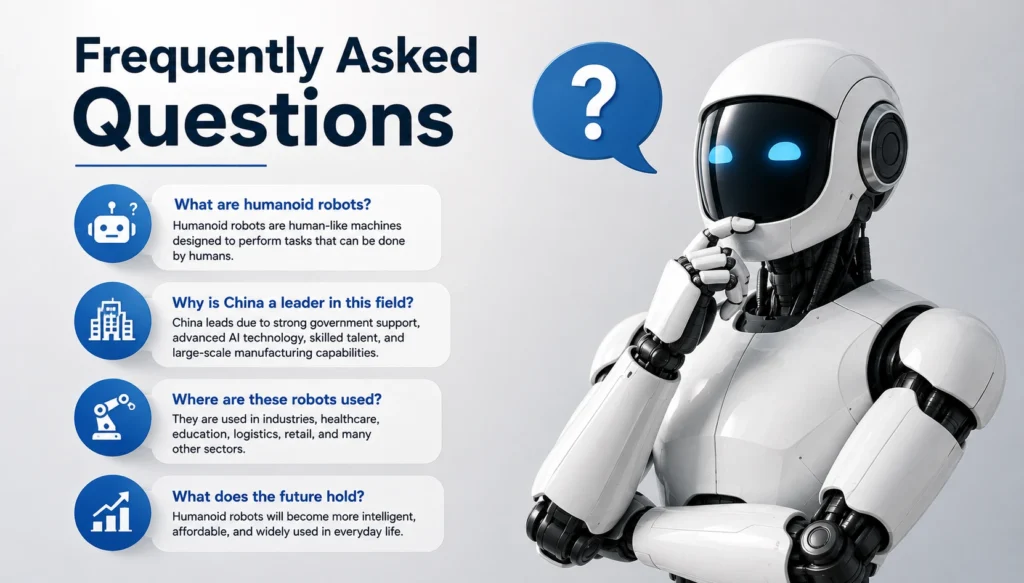
What is a humanoid robot?
A humanoid robot is an AI-powered machine designed with a human-like body structure that can perform tasks using movement, vision, sensors, and intelligent decision-making.
Why is China investing heavily in humanoid robots?
China sees humanoid robotics as a strategic technology that can strengthen manufacturing, address labor shortages, and accelerate AI-driven industrial innovation.
Which Chinese company makes the best humanoid robot?
Companies such as Unitree Robotics, UBTECH, AgiBot, EngineAI, and Fourier Intelligence are among the leading developers, each focusing on different industries and applications.
Where are China’s humanoid robots being used today?
They are being deployed in manufacturing, logistics, healthcare, education, research, retail, and customer service, with commercial use expanding each year.
Will humanoid robots replace human workers?
No. Their primary role is to support people by handling repetitive, dangerous, or physically demanding tasks while humans continue managing work that requires creativity, judgment, and communication.
Conclusion
China’s humanoid robots are no longer just experimental machines; they are becoming practical solutions for real-world industries. Powered by artificial intelligence, advanced engineering, and a strong manufacturing ecosystem, these robots are transforming how businesses approach automation, productivity, and innovation. From factories and warehouses to healthcare and customer service, their applications continue to expand as the technology becomes smarter and more affordable.
While challenges such as battery life, development costs, and AI safety still need attention, the pace of innovation suggests that humanoid robots will play an increasingly important role in the years ahead. As China continues investing in robotics research and commercial deployment, it is well positioned to shape the future of intelligent automation. Understanding how these robots work today provides valuable insight into the technologies that will influence tomorrow’s workplaces, industries, and everyday life.
✨ Want bite-sized tech wisdom? Follow Tech Baaz.