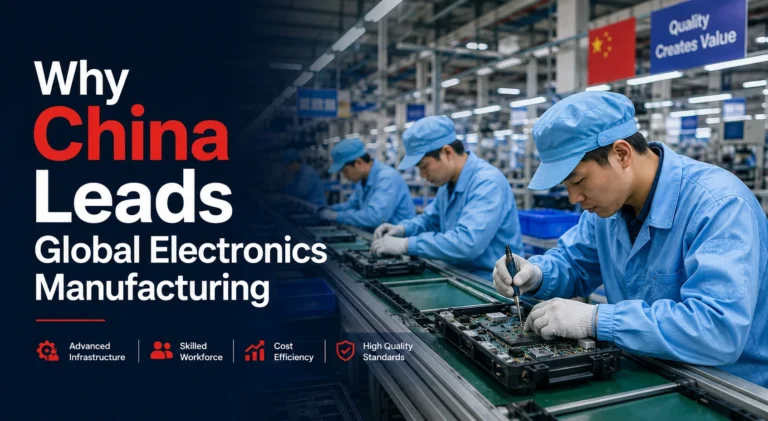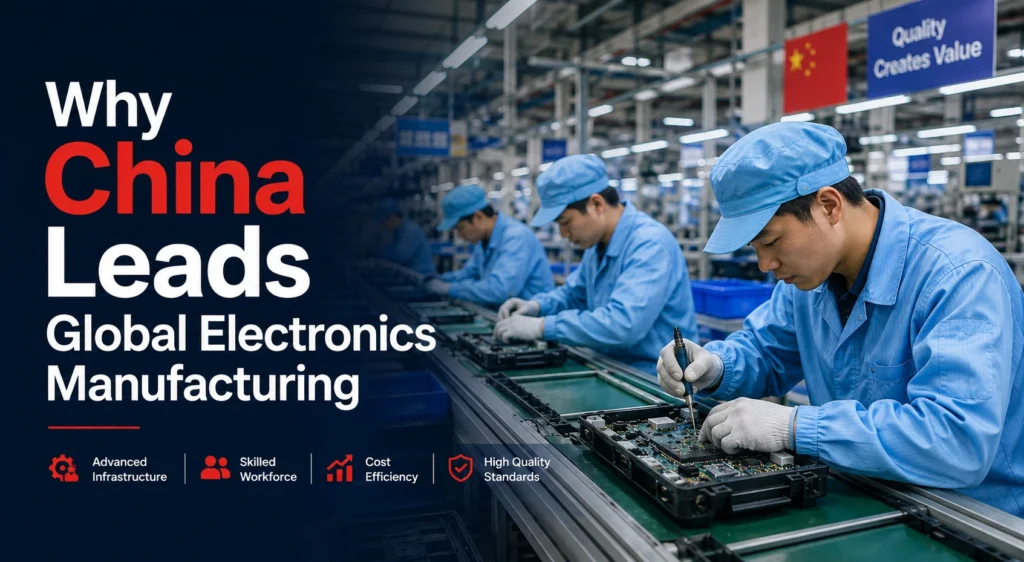
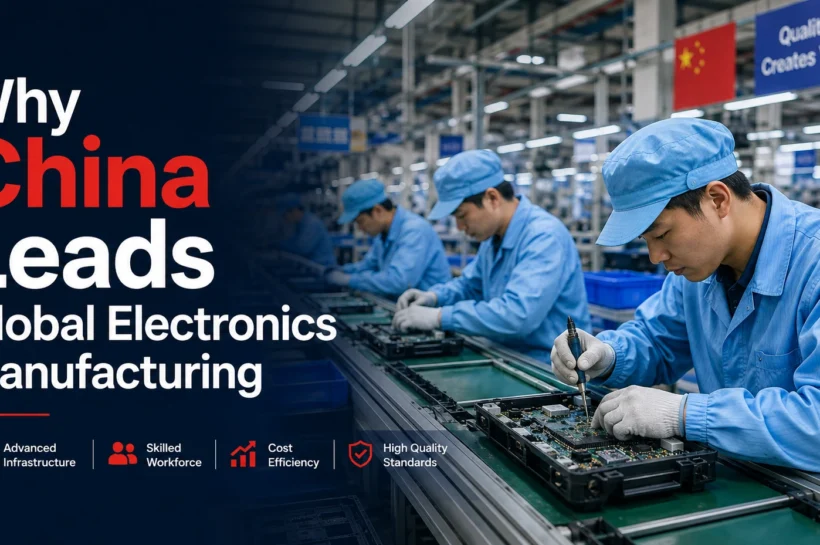

Why China Leads Global Electronics Manufacturing
China leads global electronics manufacturing because it offers something few countries can match: a supplier base, huge production capacity, skilled labor, modern infrastructure, and fast access to components. The advantage is not simply cheap labor. Manufacturers can source parts, build prototypes, adjust designs, assemble products, test them, and ship large orders through connected industrial networks. China’s Ministry of Industry and Information Technology reported that the country’s electronics manufacturing industry grew 11.8% in value added in 2024, showing the sector remains a major industrial force. That scale makes production faster, more flexible, and easier to coordinate.
How China Built Its Electronics Industry
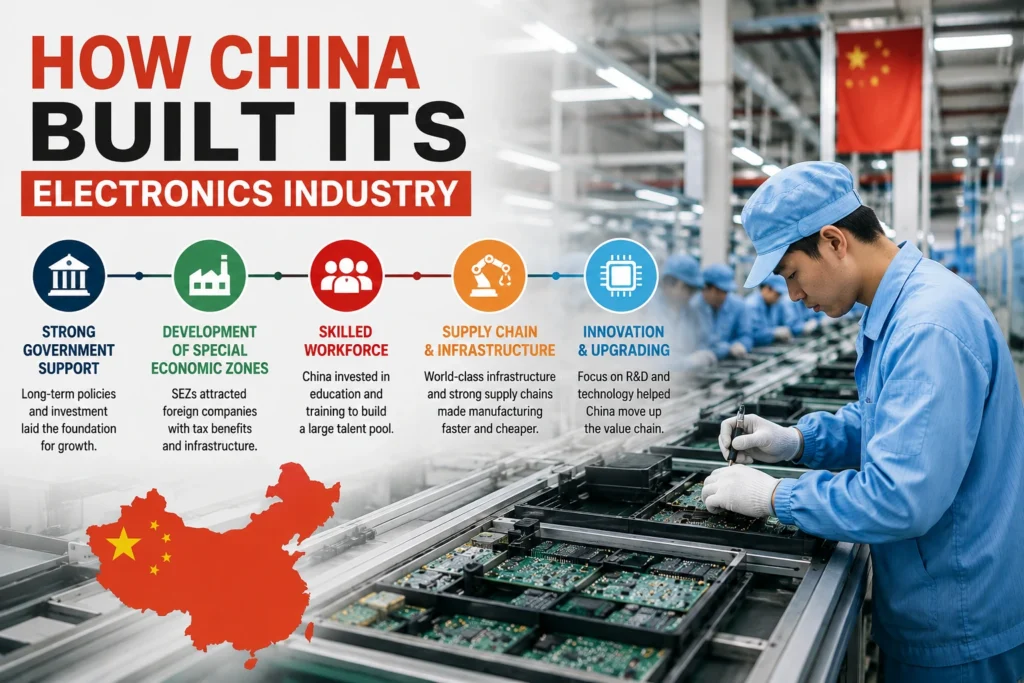
China’s electronics industry did not become dominant overnight. Years of investment in factories, ports, industrial parks, technical training, and export infrastructure created a manufacturing base that could support complex products. Foreign companies also helped develop local production capabilities by bringing technology, orders, quality requirements, and international supply-chain practices. Over time, specialized factories formed around major electronics centers, making it easier for companies to find suppliers and move from design to production. Today, China’s advantage comes from accumulated industrial experience: manufacturers can draw on an established ecosystem rather than building an entire supply chain from scratch.
💚 You might also like: Woeken Explained: Meaning, Uses & Online Popularity
Early Manufacturing Growth
China’s manufacturing expansion accelerated after economic reforms opened the country to foreign investment and international trade. Export-oriented factories grew rapidly in coastal regions with strong infrastructure and access to global markets. Electronics became part of this transformation as companies sought production bases for computers, phones, and appliances. The result was growth in factories, engineering skills, supplier relationships, and production know-how.
Strong Supplier Networks
As electronics production expanded, Chinese manufacturers developed networks of specialized suppliers. One factory might produce circuit boards, another housings, another connectors, and another metal parts. These businesses can work closely together because they operate within one ecosystem. That proximity reduces communication delays and makes it easier to solve production problems quickly. It also gives manufacturers sourcing options when a component changes quickly.
Electronics Manufacturing Clusters
Industrial clusters helped turn factories into connected production ecosystems. Shenzhen, Dongguan, and other manufacturing centers brought together electronics makers, component suppliers, engineering firms, logistics providers, and service companies. This concentration makes supplier discovery easier and speeds communication. It also creates a pool of workers familiar with electronics production. Over time, these relationships build knowledge that new manufacturing locations cannot easily reproduce.
Shenzhen provides a clear example of this concentration. Official city statistics show that Shenzhen had 142,418 industrial enterprise legal entities at the end of 2023, with computer, communications, and other electronic equipment manufacturing representing the largest industrial category by number of firms. The city also reported that its new-generation electronic information industry generated about 571.7 billion yuan in added value in 2023.
China’s Complete Electronics Supply Chain
China’s electronics supply chain is a major reason manufacturers can move from an idea to a finished product with fewer delays. The ecosystem covers components, materials, printed circuit boards, mechanical parts, assembly, testing, packaging, and logistics. Many suppliers operate close to major manufacturing centers, allowing factories to communicate quickly and adjust orders when designs change. This matters because electronics production rarely follows a perfectly fixed plan. Components may need replacement, specifications can change, or demand may rise suddenly. China’s dense supply network gives manufacturers the flexibility to respond while keeping production moving smoothly and reliably.
Electronic Components and Materials
Chinese electronics manufacturers can source a wide range of components and materials through established supplier networks. These include semiconductors, displays, batteries, connectors, sensors, PCBs, plastics, metals, and packaging materials. Not every component is produced domestically, but the breadth of local suppliers reduces the distance between many critical inputs and assembly facilities. That makes purchasing, quality checks, and production planning easier.
Manufacturing and Assembly
Once components arrive, specialized factories can handle surface-mount assembly, mechanical integration, wiring, firmware loading, and final product assembly. Manufacturers often specialize in particular processes or product categories, allowing companies to choose partners based on technical needs and production volume. This specialization helps turn complex products into coordinated manufacturing steps without requiring one factory to perform every task itself at scale.
Testing and Packaging
Testing and packaging are closely connected to production because electronics must meet performance, safety, and appearance requirements before shipment. Chinese manufacturers can integrate inspection, functional testing, reliability checks, labeling, and packaging into established production workflows. Keeping these services within the same manufacturing ecosystem can reduce handoffs and make it easier to identify defects, correct problems, and prepare goods for export.
Supplier Access and Coordination
Supplier proximity makes coordination easier when a product needs changes. Engineers can communicate with component makers, tooling companies, assembly plants, and quality teams without managing every issue across distant time zones. This can shorten feedback loops during prototyping and production. For brands launching new electronics, that responsiveness can be as valuable as the factory’s quoted unit price during production periods.
China’s Main Manufacturing Advantages
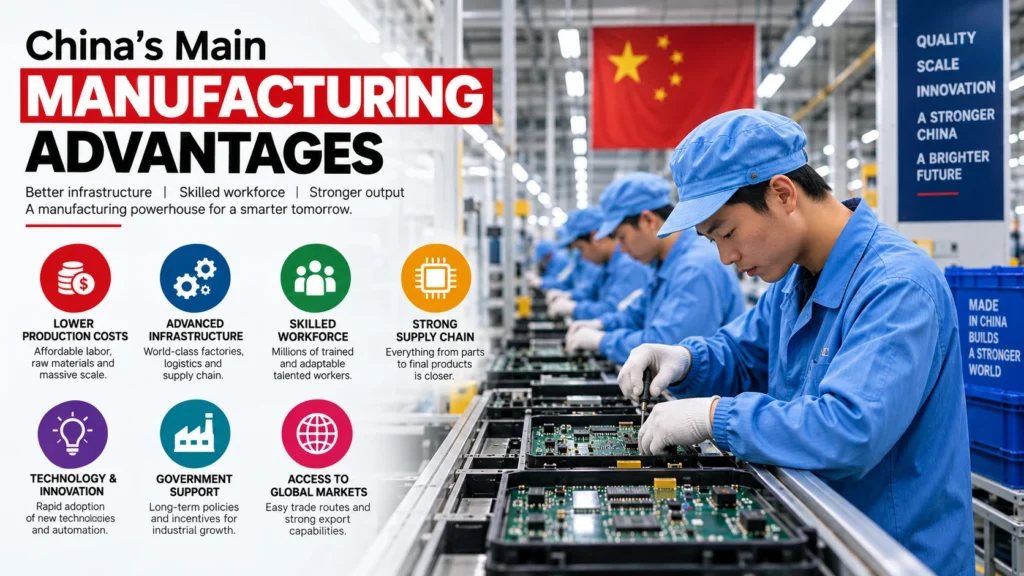
China’s electronics industry has several advantages working together rather than relying on one low-cost factor. Manufacturers can produce at very large volumes, find experienced workers, source many inputs locally, and move quickly between design, tooling, assembly, and shipping. This combination helps companies control both time and production costs. The scale is still expanding: China’s Ministry of Industry and Information Technology reported that large-scale electronic information manufacturing value added increased 14% year over year during January–April 2026. That growth shows why China remains important for companies seeking both high-volume production and an established manufacturing ecosystem.
💚 You might also like: Best Chinese Drones in 2026: Top Brands & Buying Guide
Large Production Capacity
China has factories capable of handling everything from small production runs to millions of units. Large capacity helps manufacturers spread tooling, equipment, and operating costs across more products. It also makes it easier to increase output when demand suddenly rises. This scale is particularly useful for consumer electronics, where product launches can create huge orders within a short period.
Skilled Workforce
China has built a large workforce with practical experience in electronics assembly, tooling, quality control, engineering, and factory operations. Workers and managers in established manufacturing regions often understand electronics production processes from years of experience. That knowledge can reduce training time, improve production consistency, and help factories respond quickly when a product or process needs adjustment.
Fast Product Development
Speed is another major advantage. Companies can move from prototype to production quickly because engineers, component suppliers, tooling companies, and assembly factories often operate within the same manufacturing ecosystem. A design problem can be discussed with suppliers, corrected, tested, and sent back into production without the long delays that can occur when every supplier is located in a different country.
Flexible Manufacturing
Chinese factories can often adjust production volumes, materials, packaging, and product specifications to match changing customer requirements. This flexibility is useful for startups testing a new product as well as established brands managing seasonal demand. A manufacturer may begin with a smaller order, refine the design, and then increase output as sales grow, without completely rebuilding its supply chain.
Electronics Manufacturing Costs by Country
Manufacturing costs are a major factor when companies choose between China and other production countries, but lower labor costs alone do not always result in lower overall manufacturing expenses. Electronics manufacturers must consider wages, components, tooling, factory efficiency, shipping, electricity, quality control, production speed, and supplier availability. China can remain competitive because several of these costs are connected within one ecosystem. Rather than comparing labor alone, businesses should evaluate the total cost of manufacturing. The following comparison is therefore best viewed as a practical market guide, not a fixed price list, because costs vary by product and factory.
| Country | Typical Cost Position | Main Cost Advantage | Key Manufacturing Strength |
| China | Low to Moderate | Strong supplier network and scale | Complete electronics ecosystem |
| Vietnam | Low | Competitive labor costs | Electronics assembly and exports |
| India | Low to Moderate | Large workforce and growing production | Expanding electronics manufacturing |
| Mexico | Moderate | Lower shipping costs to North America | Nearshoring and final assembly |
| United States | High | Automation and advanced technology | High-value and specialized production |
China’s Infrastructure and Technology
China’s manufacturing advantage is also supported by infrastructure that connects factories with suppliers and global markets. Major industrial regions have extensive highways, railways, ports, airports, warehouses, and industrial parks. Technology is strengthening that foundation through automation, digital production systems, robotics, and improved quality-control processes. China is also moving beyond traditional low-cost assembly. In the first four months of 2026, its large-scale electronic information manufacturing sector recorded 14% year-over-year growth in value added, while integrated-circuit output increased 24.7%.
Why Global Companies Still Manufacture in China
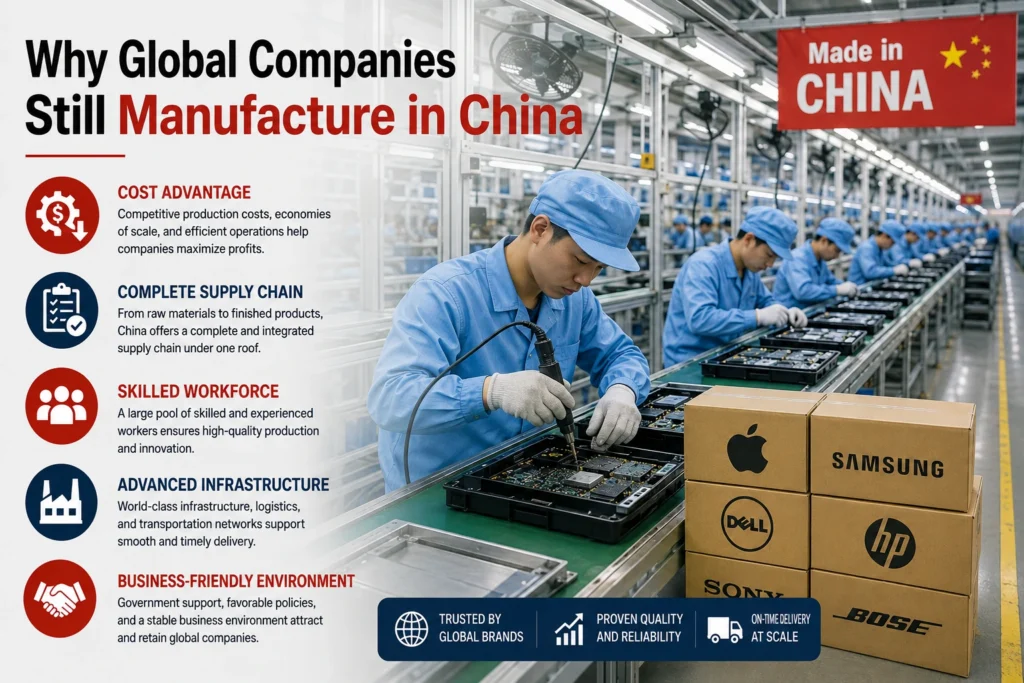
China remains attractive to global electronics companies because manufacturing decisions involve much more than factory wages. Businesses also need reliable suppliers, quick production, engineering support, consistent quality, and efficient shipping. China brings many of these advantages together in one established ecosystem. That is especially valuable for companies producing smartphones, computers, appliances, automotive electronics, and other products with complex supply chains. Even when another country offers cheaper labor, moving production can create new costs and delays if components, tooling, engineers, and specialized suppliers are located elsewhere. For many brands, China’s combination of scale, speed, supplier access, and infrastructure still makes manufacturing there commercially practical.
Faster Production
Speed can make a major difference in electronics. Manufacturers can often source components, create tooling, build prototypes, test products, and begin larger production runs within the same regional ecosystem. Shorter distances between suppliers also make communication and troubleshooting easier. When a company needs to change a component or modify a design, the factory can often coordinate with suppliers without waiting for long international shipping cycles. This helps brands respond faster to market demand and bring new products to customers sooner.
Competitive Total Costs
China is not always the country with the lowest hourly wages, but its overall manufacturing costs can remain competitive. High production volumes, efficient factories, local component suppliers, established tooling businesses, and strong logistics can reduce the cost of getting a finished product ready for sale. This is why businesses should compare total production expenses rather than looking only at labor rates. A slightly higher wage can sometimes be offset by faster production, fewer delays, lower sourcing costs, and better factory utilization.
Access to Reliable Suppliers
A mature supplier network gives manufacturers more choices when they need components, packaging, tooling, testing, or specialized production services. Companies can also develop long-term relationships with suppliers and improve those partnerships over multiple product cycles. This reduces the need to search for new vendors every time a product changes. For electronics brands, that continuity can be extremely valuable because a stable supplier network supports better quality control, faster problem-solving, and more predictable production schedules.
The Future of Electronics Manufacturing in China
China’s role in electronics manufacturing is changing rather than simply disappearing. Rising labor costs, trade restrictions, geopolitical tensions, and supply-chain diversification are encouraging some companies to expand production in countries such as Vietnam, India, and Mexico. However, China continues investing heavily in automation, advanced electronics, semiconductors, electric vehicles, industrial equipment, and other high-value industries. According to China’s Ministry of Industry and Information Technology, the country’s electronic information manufacturing industry maintained double-digit growth in early 2026.
The China+1 strategy is therefore becoming more common, but it does not necessarily mean companies are abandoning China. Instead, many businesses are spreading production across several countries while continuing to source important components, equipment, and expertise from Chinese suppliers.
China’s biggest long-term advantage may be the depth of its manufacturing ecosystem. Other countries can compete on wages or attract individual factories, but reproducing decades of supplier relationships, industrial clusters, engineering experience, logistics infrastructure, and production capacity is much harder. That ecosystem gives China a strong foundation for remaining one of the world’s most important electronics manufacturing centers.
Frequently Asked Questions
Why is China the largest electronics manufacturer?
China has a huge supplier network, skilled workforce, large factories, advanced infrastructure, and efficient logistics, allowing companies to produce electronics quickly and at scale.
Is manufacturing electronics in China still affordable?
Yes. China may not always have the lowest wages, but its supplier density, production efficiency, and manufacturing scale can keep total production costs competitive.
Which Chinese city is famous for electronics manufacturing?
Shenzhen is one of the world’s best-known electronics manufacturing hubs, with extensive component suppliers, factories, engineering services, and technology companies.
Why do companies manufacture electronics in China?
Companies benefit from established suppliers, fast production, flexible manufacturing, skilled workers, strong infrastructure, and access to a complete electronics supply chain.
Can Vietnam or India replace China?
Vietnam and India are expanding their electronics industries, but replacing China completely is difficult because China has a much deeper and more connected manufacturing ecosystem.
Is China still important for electronics manufacturing?
Yes. China remains highly important because of its massive production capacity, supplier networks, infrastructure, and growing focus on advanced electronics and automation.
Conclusion
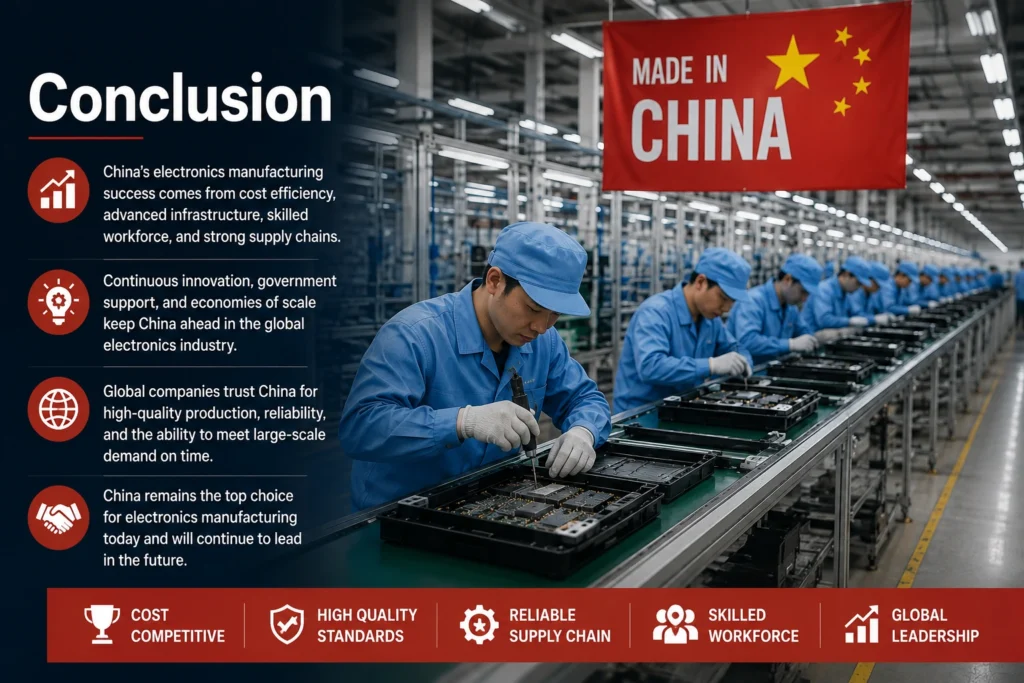
China leads global electronics manufacturing because its advantage is built from many connected strengths. It has massive production capacity, experienced workers, dense supplier networks, specialized industrial clusters, strong infrastructure, and efficient logistics. These factors allow companies to source components, develop products, manufacture at scale, and reach international markets efficiently.
The future will likely be more diversified, with Vietnam, India, Mexico, and other countries taking a larger role in global electronics production. Still, China’s established ecosystem gives it an important advantage. For companies that need scale, speed, supplier access, and manufacturing expertise in one place, China remains a powerful choice for electronics production.
✨ Want bite-sized tech wisdom? Follow Tech Baaz.